
P0740 Trouble Code: Meaning, Causes, Symptoms & Fixes
In This Guide
One-line meaning: P0740: Torque Converter Clutch Circuit Malfunction.
What the P0740 Code Means
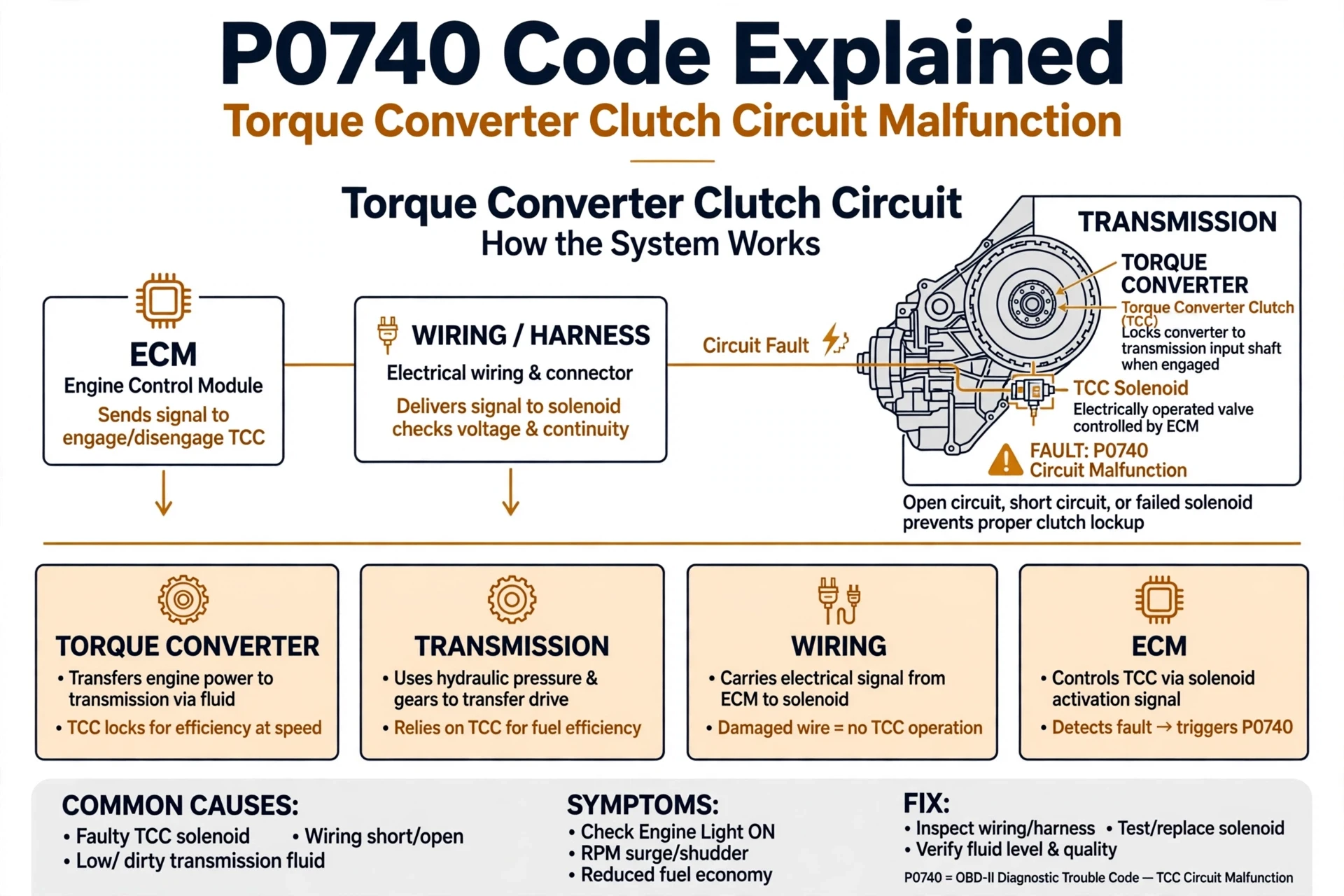
The P0740 code is one of the most searched transmission trouble codes, and its full definition is “Torque Converter Clutch Circuit Malfunction” (p0740 torque converter clutch circuit malfunction). In plain English, your car’s transmission computer has spotted an electrical fault in the circuit that operates the torque converter clutch, the device that locks the transmission to the engine at cruising speed.
Here is what is supposed to happen. The torque converter sits between the engine and the transmission. Around town it works through fluid, which is smooth but slightly wasteful. At steady highway speeds, an internal clutch (the TCC) locks up and creates a direct mechanical link between engine and transmission. That lockup improves fuel economy and keeps transmission temperatures down.
The powertrain control module (PCM) or transmission control module (TCM) operates that clutch through an electronic solenoid. When the computer commands lockup and then detects an open circuit, or never sees the lockup response it expects, it stores the P0740 code and turns on the check engine light.
P0740 (p0740 obd2, p0740 code) is a generic powertrain code, so it means the same thing on every make and model, from a Honda Accord to a Dodge Grand Caravan to a Chevy Silverado. Exact manufacturer descriptions can differ slightly, but the core fault is always the TCC circuit. Its close relatives, P0741 through P0744, describe other misbehavior in that same circuit.
Symptoms of the P0740 Code
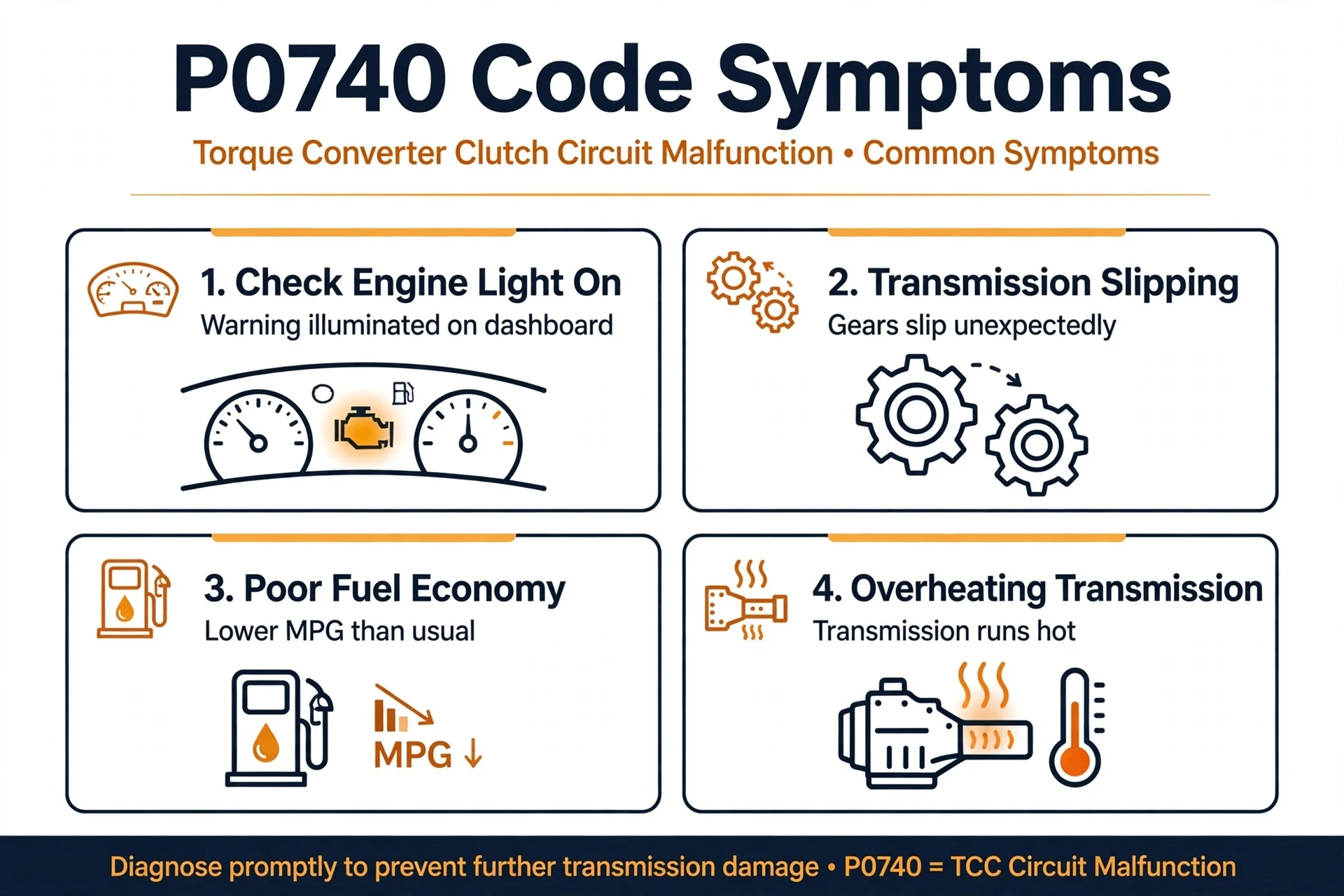
Sometimes the check engine light is the only symptom you will notice at first, which is why the p0740 code surprises so many drivers. But because the converter is slipping when it should be locked, you may also notice:
- Slipping, shuddering, or delayed engagement around highway speeds
- Higher than normal engine RPMs at cruising speed
- Reduced fuel economy, often roughly 5 to 10 percent worse
- Harsh or erratic shifting
- Transmission running hotter than usual
- Engine stalling when coming to a stop (rare, and usually means the clutch is stuck engaged instead)
What is code P0740 trying to tell you? In short: the torque converter clutch is not locking up the way the computer expects, so the transmission is wasting energy as heat instead of sending it to the wheels. Do not ignore it just because the car still moves.
Common Causes of P0740
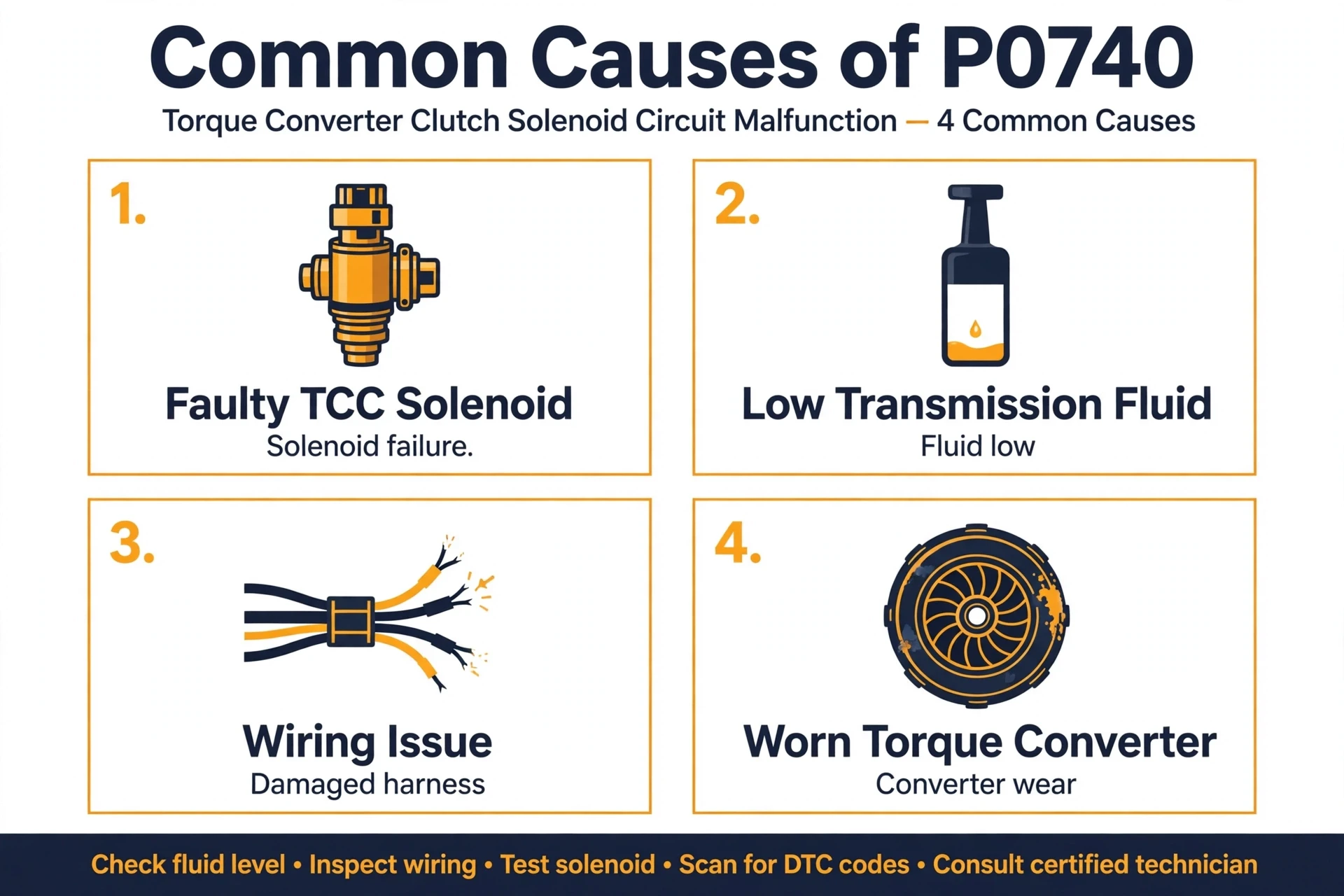
The most common cause of a P0740 code is a failed torque converter clutch solenoid, the small electrical valve the computer uses to engage the clutch. But the circuit has several weak links, and condemning the solenoid without testing is how drivers waste money on this code. Here are the causes, roughly in order of likelihood:
- Defective TCC solenoid: the solenoid inside the transmission has failed or burned out and no longer responds to the computer’s commands.
- Wiring or connector problems: frayed wires, corroded pins, or a damaged harness between the computer and the transmission interrupt the signal.
- Low transmission fluid: low fluid level or low pressure keeps the clutch from applying even when the solenoid works fine. This is the first thing to check.
- Contaminated fluid or clogged filter: burnt, dirty fluid or a restricted filter starves the solenoid and clutch of the pressure they need.
- Worn torque converter: internal wear or mechanical failure inside the converter itself prevents proper lockup.
- Faulty PCM or TCM: rare, but the computer itself can fail to send or read the clutch signal correctly, sometimes fixable with a software update.
- Internal transmission damage: worn clutches, a failing valve body, or other internal wear can keep the TCC circuit from working.
- Faulty sensor: a bad input, such as a faulty speed sensor or temperature sensor, can inhibit lockup and set the code.
How to Diagnose P0740 (Do This Before Buying Parts)
Mechanics see the P0740 code misdiagnosed constantly. The code names the TCC circuit, but the real fault is often as simple as low fluid. Follow this order:
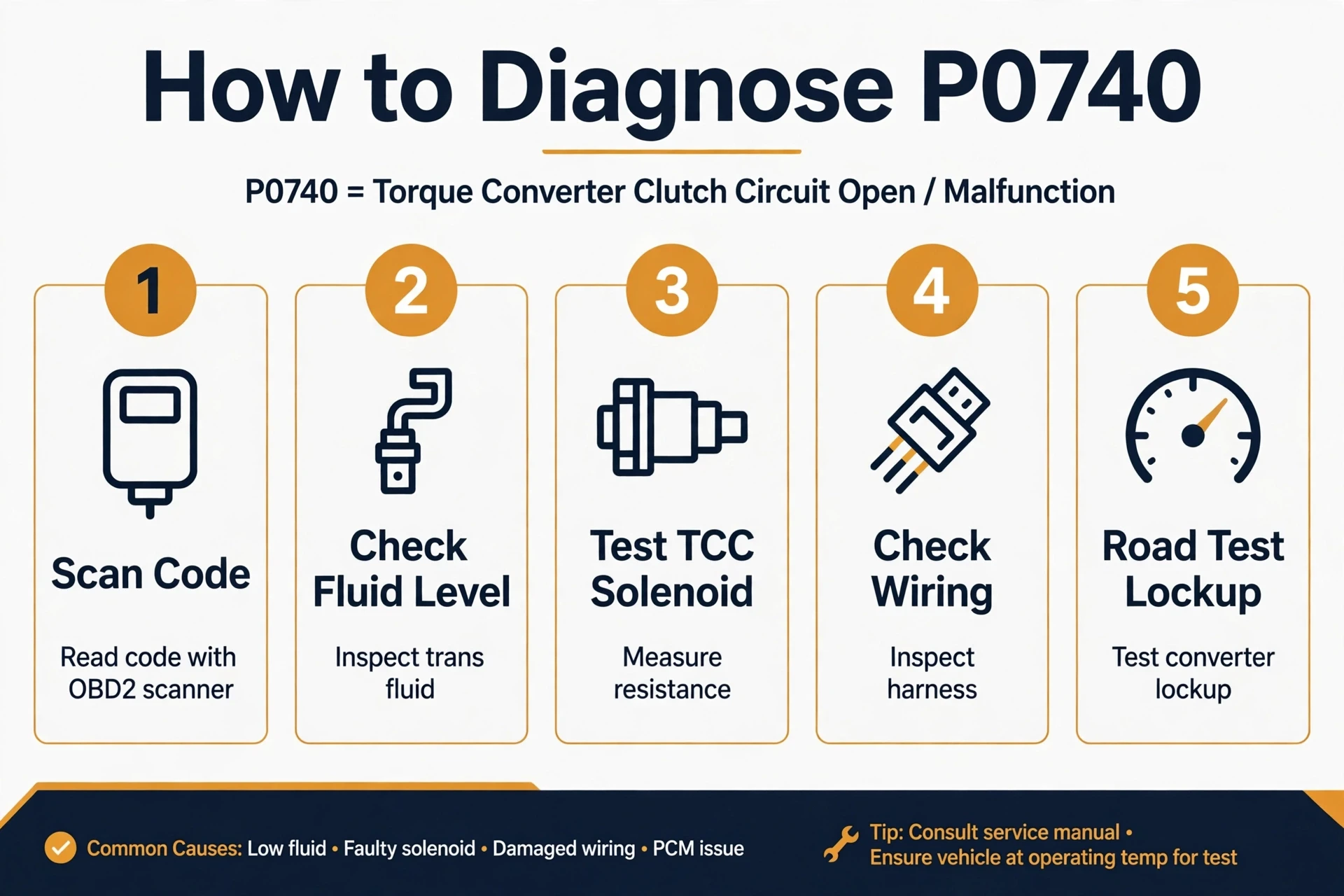
- Scan for companion codes first. If you also have shift solenoid codes, speed sensor codes, or a P0700, diagnose those alongside P0740, since they share the same wiring and computer.
- Check the transmission fluid. With the engine warm and running, check the level, color, and smell. Healthy fluid is reddish and clean; dark, burnt-smelling fluid is a red flag. Top up or service it if needed.
- Test the TCC solenoid with a multimeter. Unplug the transmission connector and measure solenoid resistance, which is typically around 5 ohms on many models. An open circuit or a way-off reading points at the solenoid or its wiring.
- Inspect the wiring and connectors. Look for frayed wires, green corrosion, bent pins, and loose connections between the computer and the transmission.
- Road test for lockup. Drive until the transmission is fully warm, cruise at a steady highway speed, then lightly touch the brake pedal without slowing down. The clutch should release and engine RPM should jump roughly 150 to 250. No change means the clutch was never locked.
- Watch TCC slip on a scan tool. If your scanner shows live data, compare engine RPM to transmission input speed at cruise. Excess slip confirms the clutch is not holding.
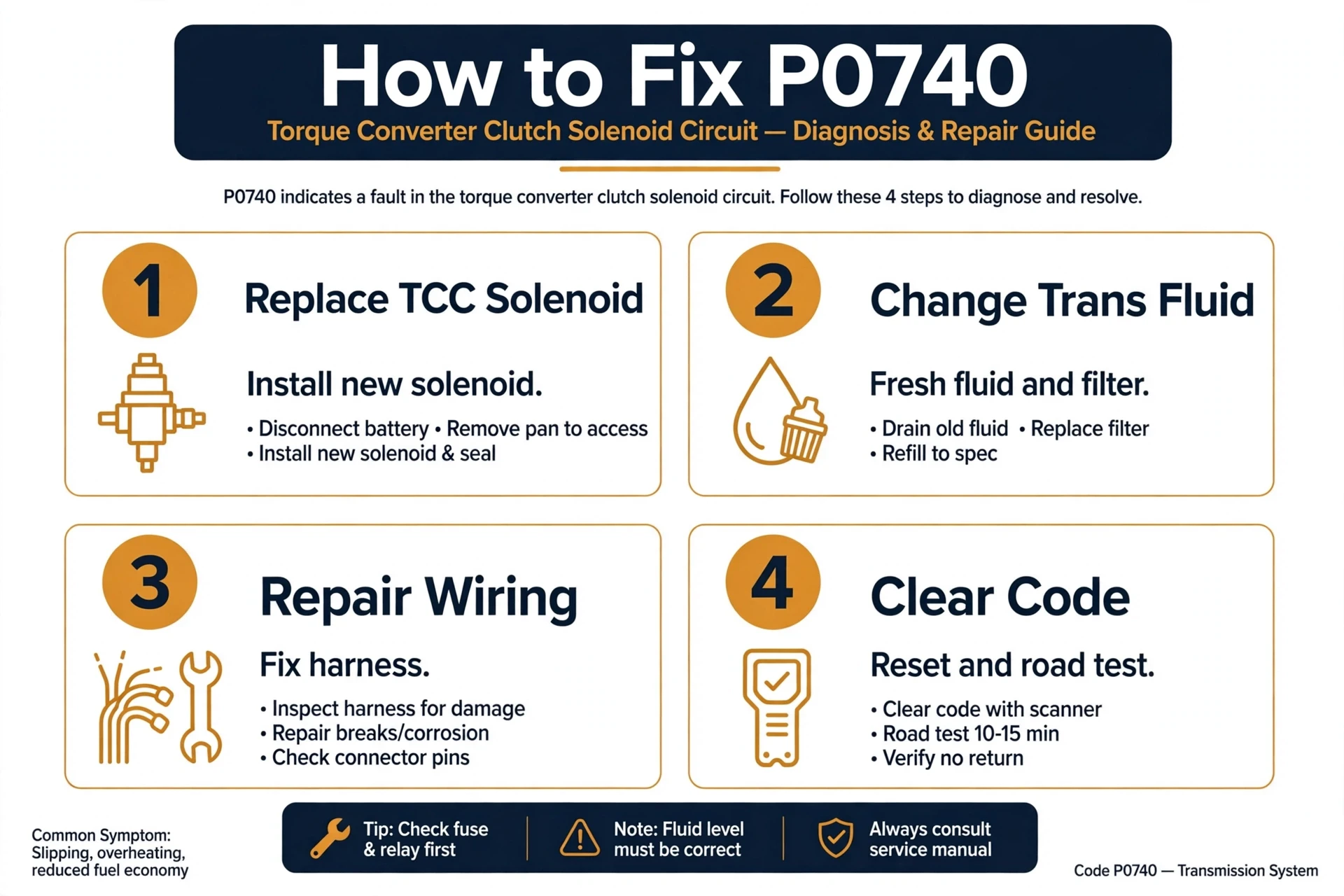
How to Fix the P0740 Code
The right fix depends on what your diagnosis found:
- Change the transmission fluid and filter: a fluid and filter service with the correct specification fluid. Fresh fluid alone resolves many p0740 code cases and is the cheapest first step.
- Replace the TCC solenoid: if the solenoid tests bad, replace it. This usually means dropping the transmission pan and sometimes the valve body.
- Repair wiring or connectors: fix frayed wires, clean corroded pins, and secure loose connectors in the TCC circuit.
- Reprogram or replace the TCM/PCM: if the computer is at fault, a software update or module replacement may be needed.
- Repair or replace the torque converter: only after confirming the converter itself has failed mechanically. This requires removing the transmission.
- Rebuild or replace the transmission: the last resort, for units with widespread internal wear. Never start here; many drivers who skip the solenoid and fluid checks pay for a rebuild they did not need.
P0740 Repair Costs
Drivers always ask how much it costs to fix P0740, and the answer depends entirely on the cause. Here are realistic ranges:
| Repair | Cost Range |
|---|---|
| Transmission fluid and filter service | $50 – $350 |
| Wiring or connector repair | $50 – $200 |
| TCC solenoid replacement | $150 – $550 |
| TCM/PCM reprogramming or replacement | $550 – $2,500 |
| Torque converter replacement | $600 – $1,500+ |
| Transmission rebuild or replacement | $1,200 – $5,500 |
This is why diagnosis matters. A $150 fluid service and a $4,000 transmission rebuild share the same code. Drivers looking for a p0740 code fix that is permanent, easy, and cheap should always start with the fluid check and the solenoid tests, not the parts catalog.
DIY vs Mechanic Verdict
You can do this at home: checking transmission fluid level and condition, reading codes with an OBD2 scanner, inspecting visible wiring and connectors, and the brake-tap road test for lockup. A fluid and filter change is also doable on many vehicles with basic tools.
See a mechanic for: TCC solenoid replacement (usually requires dropping the pan and working inside the transmission), torque converter replacement (the transmission has to come out), TCM programming, and any diagnosis that stays unclear after the basic checks. A shop can also monitor TCC slip data on a professional scan tool in minutes.
Bottom line: check the cheap stuff yourself, and let a pro open up the transmission.
Can You Drive With a P0740 Code?
Usually yes, for a short time. The car will generally keep moving through the gears. But driving long term with P0740 is not advisable: fuel economy drops, the transmission runs hotter because the slipping converter makes extra heat, and sustained heat breaks down the fluid and wears internal parts. That can turn a solenoid or fluid job into a full rebuild. Get it diagnosed soon, even if the car feels mostly fine.
P0740 on Popular Vehicles
P0740 can appear on any automatic, but some patterns are worth knowing:
- Honda and Acura (2000-2015, Accord, Odyssey, Civic, TL): the p0740 honda accord pattern (honda p0740, p0740 code honda) is well documented on these models; check fluid condition and the TCC solenoid first.
- Dodge and Chrysler (2005-2014, 41TE transmission): the p0740 dodge grand caravan (dodge p0740, p0740 code dodge) often traces to the solenoid pack or its wiring; factory diagnostic procedures for these vans start with solenoid resistance checks.
- Toyota and Lexus (1998-2012, Camry, Sienna, Corolla): the p0740 toyota camry code (toyota p0740, p0740 code toyota) frequently comes down to fluid condition or the lockup solenoid.
- GM (Chevrolet, GMC, Cadillac with 4L60E/4L80E): the p0740 chevy silverado (chevy p0740, p0740 code chevy) commonly involves the TCC solenoid or its wiring; on some GM models, multiple transmission codes appearing together can also point to an ignition switch issue, so check for companions.
- Jeep and Nissan: p0740 jeep and p0740 nissan searches (p0740 code nissan, p0740 code jeep wrangler) usually resolve the same way: fluid, solenoid, wiring, in that order.
EOBD P0740 and OBD P0740 are the same code under different naming (European vs generic OBD-II). DTC P0740 and OBD-II P0740 also refer to the identical fault.
P0740 vs Related Codes
P0740 is the general “circuit malfunction” code for the torque converter clutch. Its siblings describe specific misbehavior in that same circuit: P0741 means the clutch circuit has a performance problem or is stuck off (the clutch will not engage), P0742 means it is stuck on (the clutch will not release, which can stall the engine at stops), P0743 flags a purely electrical fault in the solenoid circuit, and P0744 means the fault is intermittent. You will often see P0700 stored alongside any of them, since that is the transmission’s general request to turn on the check engine light. Diagnose them the same way: fluid, wiring, solenoid, then the converter.
Related Codes
- P0741: Torque Converter Clutch Circuit Performance or Stuck Off
- P0742: Torque Converter Clutch Circuit Stuck On
- P0743: Torque Converter Clutch Circuit Electrical
- P0744: Torque Converter Clutch Circuit Intermittent
- P0700: Transmission Control System Malfunction (often stored with P0740)
- P2769: Torque Converter Clutch Circuit Low
Video Walkthrough
Watch the video above for a visual walkthrough of P0740 causes and diagnosis before you read on.
Frequently Asked Questions
What is the most common cause of a P0740 code?
A failed torque converter clutch solenoid or damaged wiring in its circuit. Low or burnt transmission fluid is the next most common trigger, which is why checking the fluid comes before buying any parts.
Can I still drive my car with a P0740 code?
Short term, yes. The car usually keeps driving normally. Long term, the slipping converter wastes fuel and overheats the transmission, which can turn a small repair into a rebuild.
How do you fix the code P0740?
Diagnose first: check for companion codes, inspect the fluid, then test the TCC solenoid and wiring. Then service the fluid, replace the bad solenoid, repair the wiring, or in rarer cases service the computer or the torque converter.
How much does it cost to fix P0740?
From about $50-$350 for a fluid and filter service and $150-$550 for a TCC solenoid replacement, up to $600-$1,500+ for a torque converter or $1,200-$5,500 for a transmission rebuild, depending on the vehicle.
Will P0740 clear itself?
Rarely. If the fault was a one-time glitch it might. Usually the code returns until the circuit problem is actually fixed.
Can low transmission fluid cause P0740?
Yes. Low fluid or low pressure keeps the clutch from applying, so the computer never sees lockup and sets the code. Check the fluid level before anything else.
Is P0740 the solenoid or the torque converter?
Most of the time it is the solenoid, its wiring, or the fluid. The torque converter itself is the culprit only after those are ruled out, so test the cheap causes first.
Conclusion
The P0740 code looks scary because it names the transmission, but it is really your car reporting an electrical problem in the torque converter clutch circuit, not an automatic death sentence for the gearbox. Check the fluid, inspect the wiring, test the solenoid, and fix what you find. Do that, and you will either solve it cheaply or know for certain the problem runs deeper. Either way, you stop guessing and start fixing.
About the author: Written by the OBD2 Code Hub editorial team. Our diagnostic guides are built from real OBD-II data, manufacturer service procedures, and hands-on troubleshooting experience, then reviewed for technical accuracy before publishing. We drive the same cars you do.