
P2000 Trouble Code: Meaning, Causes, Symptoms & Fixes
In This Guide
One-line meaning: P2000: NOx Trap Efficiency Below Threshold (Bank 1).
What the P2000 Code Means
The P2000 code is a diesel and lean-burn engine code that drivers usually meet after an emissions-related check engine light. Its full definition is “NOx Trap Efficiency Below Threshold (Bank 1)” (p2000 nox trap efficiency below threshold bank 1). In plain English, your vehicle’s computer (ECM/PCM) has decided that the NOx trap on bank 1 (p2000 bank 1), the side of the engine that contains cylinder number one, is no longer capturing nitrogen oxides well enough to meet emissions standards.
Here is the background. Diesel engines and lean-burn gasoline engines run with excess air, which creates high levels of nitrogen oxides (NOx). A regular catalytic converter cannot clean those up under lean conditions, so these vehicles use a NOx trap, also called a NOx adsorber or lean NOx trap. Its catalyst material grabs and stores NOx during lean driving, then the computer briefly runs the engine rich to purge the trap, converting the stored gases into harmless nitrogen.
Here is how your car figures this out. NOx sensors sit before and after the trap and report nitrogen oxide levels to the computer. When the trap is healthy, the downstream reading is much lower than the upstream one. When the two readings get too close, the computer knows the trap has lost efficiency and stores the P2000 code. Code P2000 (p2000 obd ii, code p2000) is a generic powertrain code, which means it has the same meaning on every make and model that uses this system, from a Ram 2500 to a Ford Mondeo to a VW Jetta TDI. Its twin is the P2001 code, the exact same fault but for bank 2.

Symptoms of the P2000 Code
In many cases, the check engine light is the only symptom you will notice at first. The vehicle may drive exactly the same as before. That is one reason the P2000 code surprises so many drivers. But depending on what is causing it, you might also notice:
- Check engine light, solid or occasionally flashing
- Reduced engine power or hesitation under load
- Limp mode, where the computer limits RPM and speed to protect the emissions system
- Poor fuel economy, you are filling up more often than usual
- Failed emissions or smog test, which matters a lot in strict states like California
- Noticeably darker exhaust smoke or a stronger exhaust smell on some diesels
What is code P2000? What is the p2000 code trying to tell you? In short: the aftertreatment system on bank 1 is not cleaning NOx like it should. Do not ignore it just because the vehicle still drives.

Common Causes of P2000
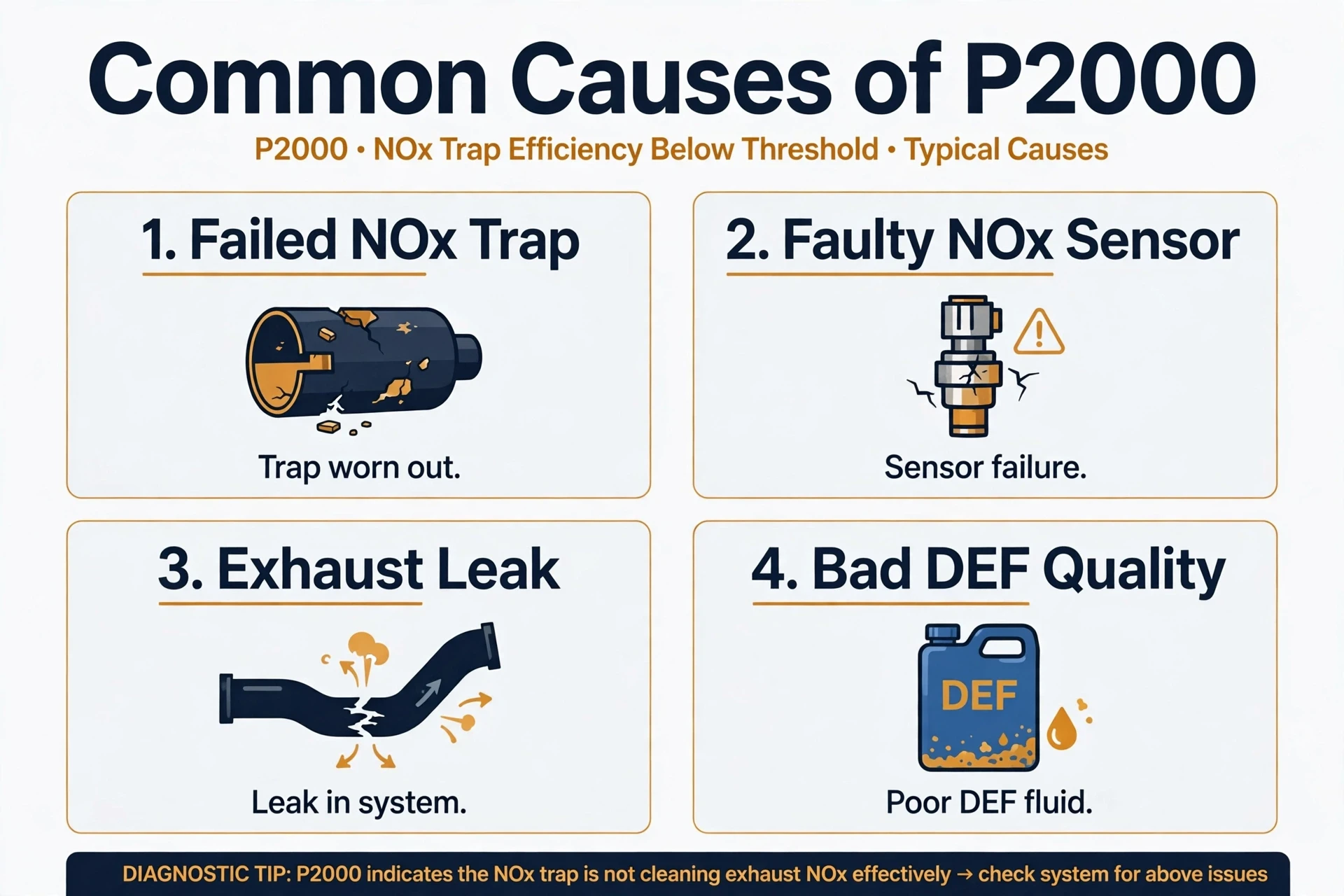
The most common cause of a P2000 code is a faulty NOx sensor feeding the computer bad data, followed closely by a NOx trap that is degraded or saturated. But a bad trap is far from the only cause, and replacing it without testing is the most expensive mistake drivers make with this code. Here are the causes, roughly in order of likelihood:
- Faulty NOx sensor: a failing or soot-fouled upstream or downstream NOx sensor sends bad data that looks like trap failure. This is the most common root cause on many trucks.
- Degraded or saturated NOx trap: the adsorber material wears out with age and heat, or gets overloaded when frequent short trips prevent the self-cleaning regeneration cycle from completing.
- Exhaust leaks: leaks between the turbocharger and the downstream sensor let outside air in and throw off the sensor readings.
- Poor fuel quality: high-sulfur diesel or contaminated fuel poisons the catalyst coating inside the trap.
- Faulty oxygen sensor or wiring: a lazy O2 sensor, or damaged NOx sensor wiring and connectors, feeds the computer wrong numbers that mimic trap failure.
- Oil or coolant contamination: oil mist or coolant leaking into the exhaust coats the trap and ruins its ability to capture NOx.
- Outdated PCM software: some factory calibrations are overly sensitive to emissions tracking. Manufacturers correct this with a technical service bulletin (TSB) reflash.
- EGR system faults: a stuck or clogged EGR valve changes exhaust chemistry and can push NOx readings out of range.
How to Diagnose P2000 (Do This Before Buying Parts)
Mechanics see the P2000 code misdiagnosed constantly. The code points at trap efficiency, but the real fault is often a sensor, a leak, or software. Follow this order:
- Check for TSBs and scan for other codes first. Look up manufacturer bulletins for your year, make, and model. If you also have NOx sensor circuit codes (P2200 series), EGR codes, or fuel system codes, fix those first. They are probably the root cause, and the P2000 may clear on its own.
- Inspect sensors and wiring. Check the upstream and downstream NOx sensors and their harnesses for soot fouling, corrosion, chafing, and loose connectors.
- Check NOx sensor live data. With a scan tool that shows live data, compare the upstream and downstream NOx readings. If both read nearly the same, the trap is weak. If one sensor reads erratically or flatlines, suspect the sensor, not the trap.
- Inspect the exhaust. Look for leaks, cracks, and black soot marks between the turbocharger and the downstream sensor. Listen for ticking or hissing that signals a leak.
- Verify regeneration. Use an advanced scan tool to check whether the trap is completing its regeneration cycles, and force a manual regeneration if the tool supports it. Lots of short trips are a classic reason the trap stays saturated.
- Rule out software and contamination. Confirm the PCM has the latest calibration, check fuel quality, and look for oil or coolant entering the exhaust before condemning the trap. If you still get a p2000 code after replacing the NOx sensor, the trap itself, or an exhaust leak you missed, is the likely culprit.

How to Fix the P2000 Code
The right fix depends on what your diagnosis found:
- Replace the faulty NOx sensor: the most common actual fix. Many technicians replace the sensor and its pigtail together if the wiring looks heat-damaged.
- Repair exhaust leaks: weld or replace the leaking section. This is often the cheapest fix and solves many P2000 cases.
- Force a regeneration or change driving habits: a long highway drive lets the system complete its self-cleaning cycle. On some vehicles a shop can trigger it with a scan tool.
- Update the PCM software: if a TSB covers your vehicle, a dealer reflash corrects overly sensitive efficiency monitoring.
- Fix oil leaks and use quality fuel: stop contamination at the source and stick to low-sulfur diesel that meets the manufacturer’s spec.
- Replace the NOx trap: only after confirming it has actually failed. The part is expensive and buried in the exhaust, so rule out sensors, leaks, and software first.

P2000 Repair Costs
Drivers always ask how much it costs to fix P2000, and the answer depends entirely on the cause. Here are realistic ranges:
| Repair | Cost Range |
|---|---|
| NOx sensor replacement (per sensor) | $200 – $450 |
| Exhaust leak repair | $100 – $300 |
| PCM software update (reflash) | $100 – $250 |
| NOx trap / adsorber replacement | $1,000 – $3,000+ |
This is why diagnosis matters. A $250 sensor job and a $2,000 trap replacement share the same code. Drivers looking for a p2000 code fix that is permanent and cheap should always start with sensor tests and the exhaust inspection, not the parts catalog.
DIY vs Mechanic Verdict
You can do this at home: reading codes with an OBD2 scanner, visual exhaust inspection for leaks and damage, checking sensor wiring and connectors, looking up TSBs for your vehicle, and taking a long highway drive to let regeneration complete. If you find an obvious exhaust leak or a clearly fouled sensor, those are reasonable DIY repairs for anyone comfortable with basic tools.
See a mechanic for: NOx sensor live-data testing, forced regeneration with a professional scan tool, PCM reflash (usually a dealer job), and NOx trap replacement (buried in the exhaust and emissions-regulated). A shop can confirm trap failure in under an hour, which is cheaper than guessing with a $2,000 part.
Bottom line: diagnose it yourself, fix the simple stuff yourself, but let a pro handle sensor calibration and the trap swap.
Can You Drive With a P2000 Code?
Generally yes, for a short time, but expect reduced power if the computer engages limp mode. Driving long term with P2000 is not advisable: fuel economy drops, you will fail any emissions or smog test, and a saturated trap puts extra strain on the rest of the aftertreatment system. Get it diagnosed soon, even if the vehicle feels fine.
P2000 on Popular Vehicles
P2000 shows up on diesels and lean-burn engines across brands, but some patterns are worth knowing:
- Ram 2500/3500 6.7L Cummins (2007-2011): the p2000 code 6.7 cummins (p2000 code cummins) is well documented on these trucks. Sensor failures and exhaust leaks cause most repeat cases, so test both before replacing the trap.
- Ford (Mondeo, Kuga diesels): the p2000 ford code (ford p2000, p2000 code ford) often appears alongside rising engine oil level complaints on diesels. Check for fuel diluting the oil as well as the code itself.
- VW / Audi TDI: the p2000 code vw (vw p2000) shows as 18432/P2000/008192 in VCDS. NOx sensor faults are the usual starting point on these cars.
- Dodge Ram diesel: the dodge p2000 code (p2000 code dodge) follows the same NOx absorber theory of operation. Test the sensors before condemning the trap.
- Nissan: the p2000 code nissan (nissan p2000) is rarer but follows the same diagnostic path. Check the sensor wiring first.
- Mercedes-Benz and Isuzu NPR: seen on some diesel applications, where DEF quality and sensor issues are worth checking on vehicles fitted with a separate SCR system.
P2000 is a generic OBD-II code, so OBD P2000, DTC P2000, and manufacturer-specific variants all refer to the same bank 1 NOx trap efficiency fault.
P2000 vs P2001
P2000 is bank 1. P2001 is the mirror image for bank 2: “NOx Trap Efficiency Below Threshold (Bank 2).” On an inline engine or single-bank setup there is only bank 1, so you will never see P2001. On V-configuration diesels, the two codes point at the two separate NOx traps. Diagnose them the same way.
Related Codes
- P2001: NOx Trap Efficiency Below Threshold (Bank 2)
- P20EE: SCR NOx Catalyst Efficiency Below Threshold (Bank 1)
- P2201: NOx Sensor Circuit Range/Performance (Bank 1, a common companion)
- P2002: Diesel Particulate Filter Efficiency Below Threshold (Bank 1)
Video Walkthrough
Watch the video above for a visual walkthrough of P2000 causes and fixes before you read on.
Frequently Asked Questions
What is the most common cause of a P2000 code?
A faulty NOx sensor is the single most common cause, followed by a degraded or saturated NOx trap. Exhaust leaks and outdated PCM software are close behind, which is why testing before replacing parts saves so much money.
Can I still drive my car with a P2000 code?
Yes, short term, though the computer may limit power in limp mode. Long term, you risk worse fuel economy, failed emissions tests, and extra strain on the aftertreatment system.
How do you fix the code P2000?
Diagnose first: check for TSBs and companion codes, test NOx sensor live data, inspect the exhaust for leaks, and verify regeneration. Then replace the bad sensor, seal leaks, update the PCM software, or replace the trap if it has truly failed.
How much does it cost to fix P2000?
From about $100-$300 for an exhaust leak repair or PCM reflash, $200-$450 per NOx sensor, up to $1,000-$3,000+ for a NOx trap replacement depending on the vehicle.
Will P2000 clear itself?
Rarely. If the trap completes a successful regeneration, it might clear temporarily. Usually the code returns until the real problem is fixed.
Can a bad O2 sensor cause P2000?
Yes. A lazy oxygen sensor or damaged NOx sensor wiring feeds the computer bad data that looks like trap failure. Always test sensors before replacing the trap.
How do I pass emissions with a P2000 code?
You cannot pass with an active P2000 in most states. Fix the underlying cause, clear the code, complete a drive cycle so the monitors run, then test.
Conclusion
The P2000 code looks scary, but it is really your vehicle asking for a proper diagnosis, not an automatic NOx trap replacement. Check for TSBs and other codes, test the NOx sensors, inspect the exhaust, and fix what you find. Do that, and you will either solve it with a sensor or a software update, or know for certain the trap is done. Either way, you stop guessing and start fixing.
About the author: Written by the OBD2 Code Hub editorial team. Our diagnostic guides are built from real OBD-II data, manufacturer service procedures, and hands-on troubleshooting experience, then reviewed for technical accuracy before publishing. We drive the same cars you do.