
P2453 Trouble Code: Meaning, Causes, Symptoms & Fixes
In This Guide
One-line meaning: The P2453 code means your diesel’s computer is getting an implausible or out-of-range signal from the DPF differential pressure sensor “A”, so it can no longer trust its measurement of how clogged the diesel particulate filter is.
What the P2453 Code Means
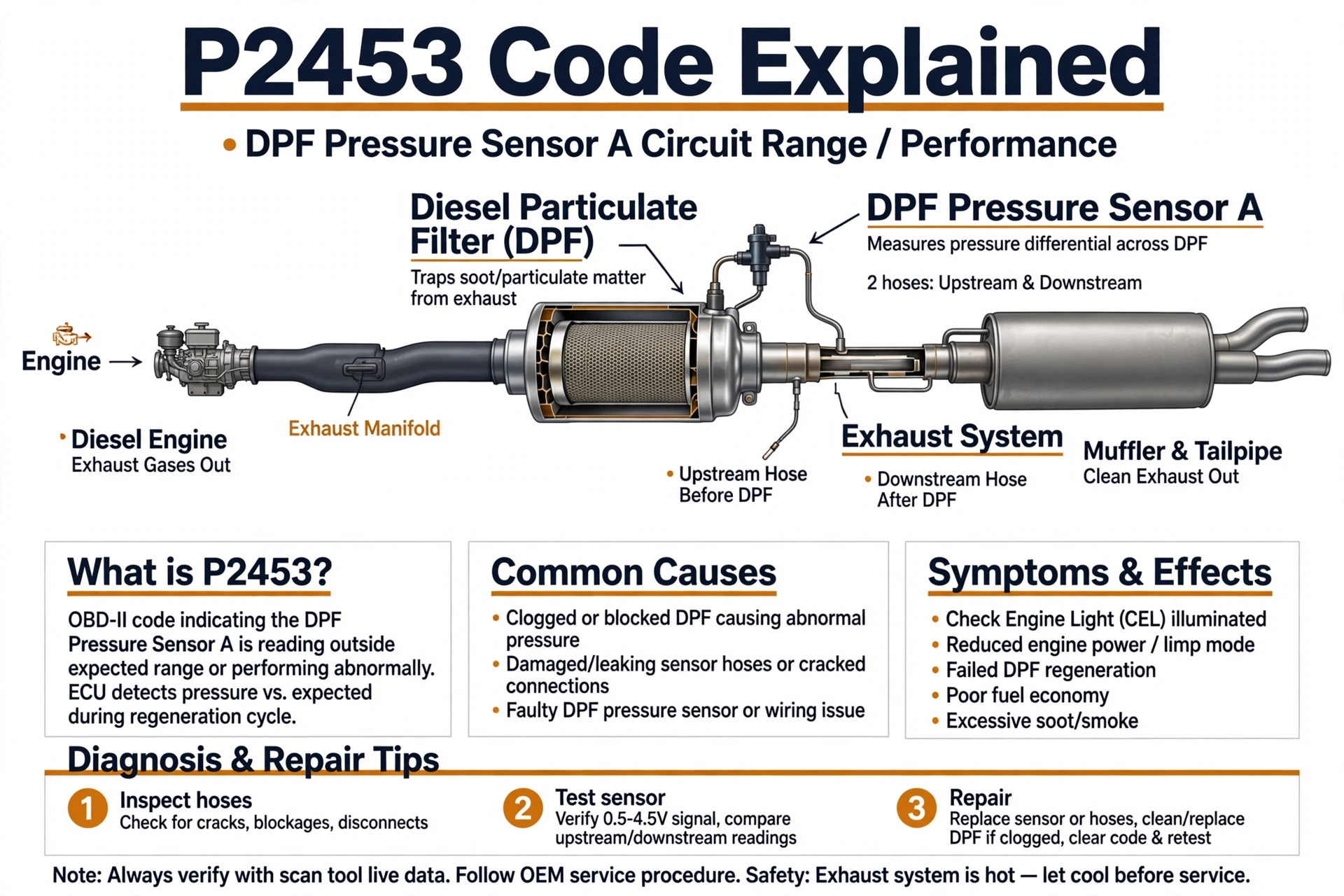
The P2453 trouble code is a generic OBD-II powertrain code with the official definition “Diesel Particulate Filter Pressure Sensor A Circuit Range/Performance”. It applies to diesel vehicles only, since only diesels use a DPF.
First, here is what is happening. Your diesel particulate filter traps soot from the exhaust. To know when the filter needs to burn that soot off (a regeneration), the engine computer watches a differential pressure sensor. This sensor reads exhaust pressure before and after the DPF through two small hoses. As a result, the difference between those readings tells the computer how loaded the filter is.
However, P2453 sets when that sensor’s signal does not add up: the voltage is present, but the value is implausible, stuck, drifting, or outside the range the computer expects for current driving conditions. This is why the code frustrates so many owners. It is rarely a clean broken wire. It is the computer doing bad math from a questionable reading, which makes it trickier to pin down than a simple open or short circuit.
Symptoms of the P2453 Code
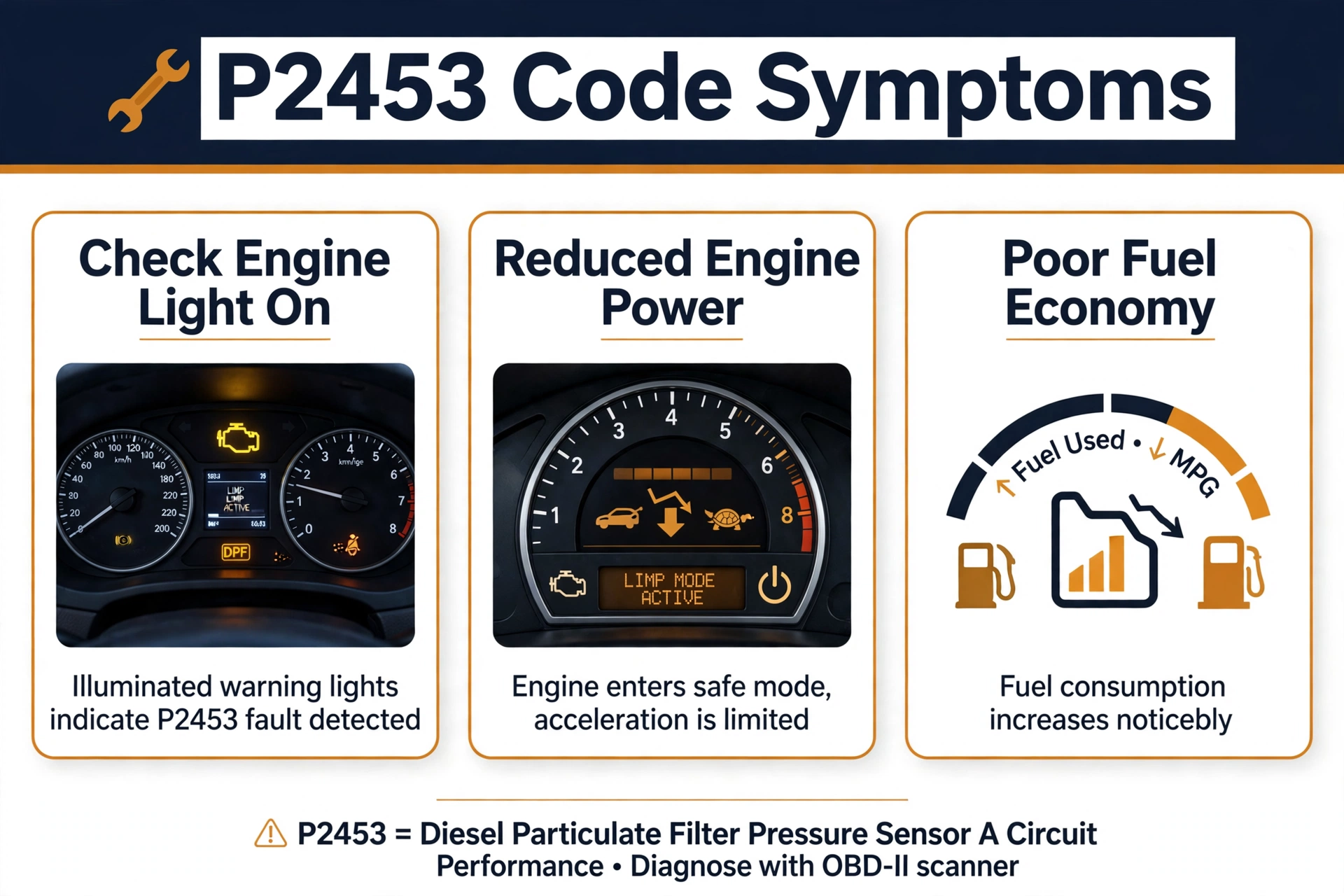
Initially, many drivers notice nothing except the check engine light. But because the computer uses this sensor to manage DPF regenerations, symptoms often follow:
- Check engine light on: the malfunction indicator lamp is the most common and sometimes only symptom at first.
- Reduced engine power / limp mode: the computer may limit power to protect the engine and emissions system.
- Poor fuel economy: failed or constant regeneration attempts waste fuel.
- Frequent, incomplete, or failed DPF regenerations: the DPF warning light may come on alongside the check engine light.
- Increased exhaust smoke or emissions: a filter that never regenerates properly starts passing soot.
Common Causes of P2453
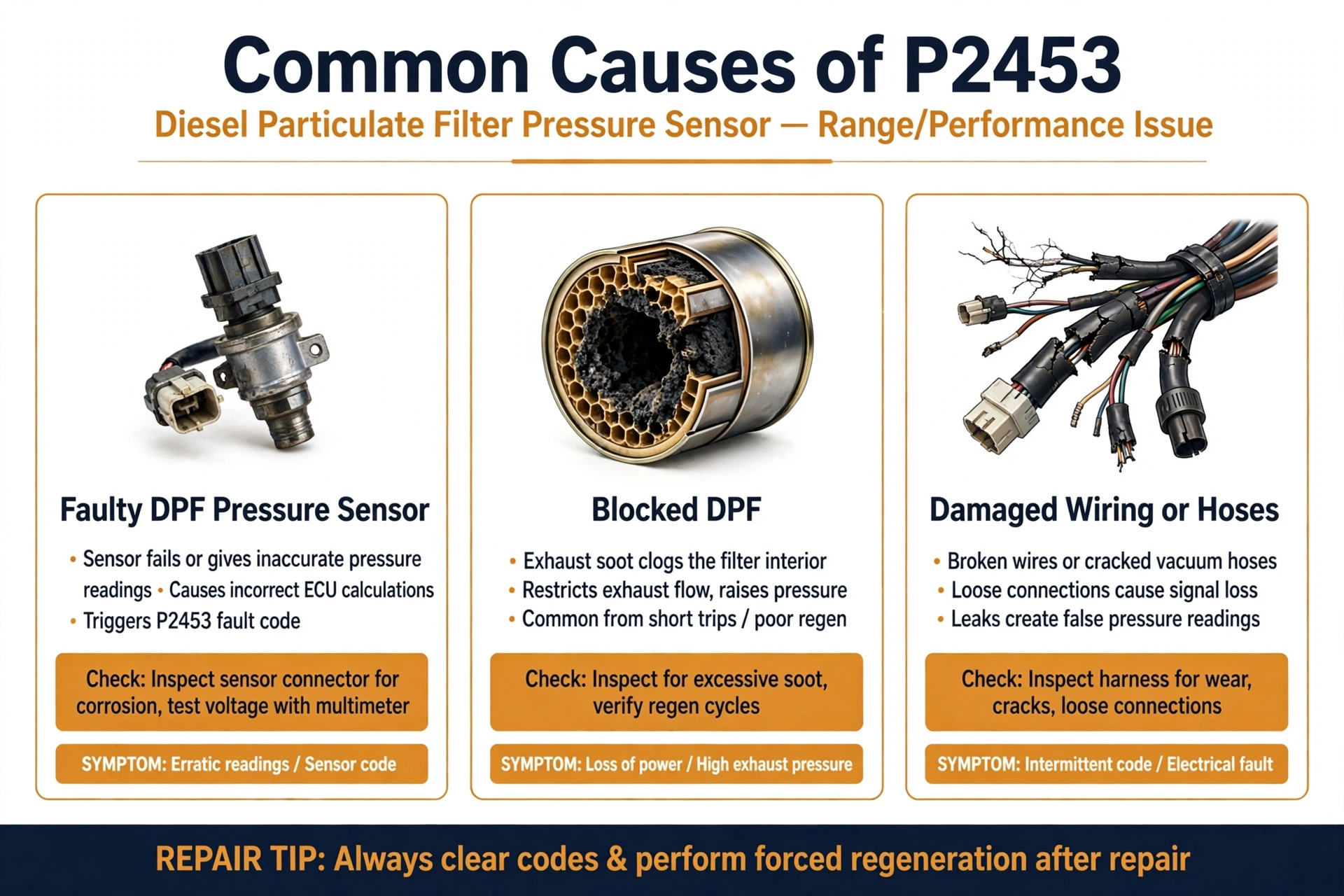
The sensor gets the blame most often, but the hoses feeding it fail just as frequently. For example, heat and vibration crack hoses long before the sensor itself wears out. Work through these in order:
- Faulty DPF differential pressure sensor (sensor A): the sensor itself fails internally or drifts out of calibration, sending a skewed reading.
- Damaged or blocked pressure hoses: the two small hoses between the exhaust/DPF and the sensor crack, melt, kink, or clog with soot, corrupting the pressure signal.
- Wiring or connector problems: corroded pins, loose connectors, or chafed wiring at the sensor distort the signal.
- Severely clogged DPF: a restricted filter creates abnormal backpressure that pushes readings outside the plausible range.
- Exhaust leaks: leaks near the DPF pressure taps change the pressures the sensor sees.
- Missing sensor reset: after a sensor replacement, skipping the differential pressure sensor reset or adaptation can bring the code right back.
How to Diagnose P2453 (Do This Before Buying Parts)
P2453 is one of the most misdiagnosed diesel codes because a new sensor will not fix blocked hoses or a clogged filter. Diagnose first:
- Scan and document everything. Record P2453 plus any companion codes and freeze-frame data before clearing anything.
- Inspect the pressure hoses. Trace both hoses from the DPF/exhaust to the sensor. Look for cracks, melting, kinks, loose fittings, and soot buildup. Disconnect them and check that air passes through freely.
- Check the wiring and connector. Look for corrosion, bent pins, chafing, and poor pin fit at the sensor connector.
- Watch live data. With a scan tool, monitor DPF differential pressure. At idle it should read near zero and rise smoothly with RPM and load. A stuck, negative, or erratic reading points to the sensor or its hoses.
- Check for exhaust leaks: next, inspect around the DPF and pressure tap points.
- Assess DPF soot load. If the filter is heavily loaded, address that before condemning the sensor.
- Reset after repair. Once fixed, perform the differential pressure sensor reset/adaptation, clear the codes, and road test through a full regen cycle to confirm.

How to Fix the P2453 Code
Ultimately, the right fix depends on what your diagnosis found:
- Replace damaged pressure hoses: new hoses with secure fittings are cheap and fix a large share of P2453 cases.
- Repair wiring and connectors: clean corrosion, repair chafed wires, and reseat the connector.
- Replace the DPF differential pressure sensor A: use an OEM-quality sensor when live data proves the sensor is lying.
- Clean or regenerate the DPF: run a forced regeneration or have the DPF professionally cleaned if soot load is high; replace the DPF if it is damaged or permanently restricted.
- Fix exhaust leaks: in addition, seal any leaks near the sensor pressure taps.
- Perform the sensor reset/relearn with a scan tool, clear the codes, and verify the fix with a drive cycle that includes a regeneration.

P2453 Repair Costs
Drivers always ask how much it costs to fix P2453, and the range is wide because a hose job and a DPF replacement share the same code. Typical US repair costs:
| Repair | Cost Range |
|---|---|
| DPF differential pressure sensor (part only) | $80 – $250 |
| DPF pressure sensor replacement (fitted) | $150 – $400 |
| Pressure hoses/lines replacement | $80 – $200 |
| Wiring or connector repair | $100 – $250 |
| Diagnostic scan with live-data test | $100 – $160 |
| Forced DPF regeneration | $150 – $350 |
| Professional DPF cleaning | $300 – $600 |
| DPF replacement | $1,500 – $4,000 |
So, this is why diagnosis matters. A $150 hose repair and a $3,000 DPF replacement start with the same code.
DIY vs Mechanic Verdict
You can do this at home: reading and clearing codes with an OBD2 scanner, visually inspecting the pressure hoses and wiring, checking live DPF pressure data, and replacing the sensor itself on many models (usually one bolt and one electrical connector).
See a mechanic for: forced regenerations, DPF removal and professional cleaning, exhaust repairs, and the sensor reset/adaptation procedure if your scan tool cannot perform it.
Bottom line: diagnose it yourself and handle the hoses, wiring, and sensor swap yourself, but let a diesel shop handle regenerations and DPF work.
Can You Drive With a P2453 Code?
Short trips are usually fine, and the truck may feel normal at first. But do not ignore it. P2453 can trigger limp mode without warning, and while the code is active the computer cannot schedule DPF regenerations correctly. A filter that never regenerates keeps loading with soot until cleaning no longer saves it, turning a sensor job into a DPF replacement. Therefore, get it diagnosed soon and avoid heavy towing or long highway hauls until it is fixed.
P2453 on Popular Vehicles
P2453 shows up across all diesel brands, but some patterns are worth knowing:
- Chevrolet Silverado / GMC Sierra (Duramax): the p2453 duramax code (duramax p2453, p2453 code duramax) on the 6.6L V8 often traces to heat-baked pressure hoses near the downpipe. Inspect the hoses before buying a sensor.
- Ford F-Series Super Duty (Powerstroke): for the p2453 ford code (ford p2453, p2453 code ford) on the 6.7L Powerstroke, check for wiring chafe where the sensor harness routes near hot exhaust parts.
- Ram 2500/3500 (Cummins): on the 6.7L Cummins, heavy towing with a heavily loaded DPF can set P2453 alongside soot-related codes. Verify soot load with live data.
- Volkswagen / Audi TDI: the p2453 vw code (vw p2453) is documented as an implausible-signal fault. A live-data check of differential pressure with a capable scan tool is the fastest test.
- Land Rover / Jaguar (2.0L diesel): the p2453 land rover code (land rover p2453) frequently comes from split or melted sensor hoses tucked tight against the exhaust.
- Vauxhall / Opel Antara (2.0/2.2 CDTI): p2453 vauxhall antara cases (vauxhall antara p2453) commonly involve soot-blocked sensor pipes that need clearing or replacing.
Across all of these, the diagnostic order never changes: hoses and wiring first, live data second, sensor last.
P2453 vs P2452, P2454 and P2463
Indeed, these codes are close cousins and often appear together. P2452 is the general DPF pressure sensor “A” circuit fault, typically an open or short. P2453 means the circuit works but the signal is out of range or implausible. P2454 means the sensor signal is stuck low, while P2455 (its mirror image) means stuck high. P2463 is different: it means the DPF itself is restricted with soot accumulation. P2453 and P2463 frequently pair up, because a lying pressure sensor keeps the computer from regenerating the filter, and the filter then genuinely clogs.
Related Codes
- P2452: Diesel Particulate Filter Pressure Sensor “A” Circuit
- P2454: Diesel Particulate Filter Pressure Sensor “A” Circuit Low
- P2455: Diesel Particulate Filter Pressure Sensor “A” Circuit High
- P2463: Diesel Particulate Filter Restriction, Soot Accumulation
Video Walkthrough
Watch the video above for a visual walkthrough of P2453 causes and diagnosis before you read on.
Frequently Asked Questions
What does the P2453 code mean?
P2453 means Diesel Particulate Filter Pressure Sensor “A” Circuit Range/Performance. The engine computer is getting an implausible or out-of-range reading from the DPF differential pressure sensor, so it cannot accurately judge DPF soot load.
What are the most common causes of a P2453 code?
A failing DPF pressure sensor, cracked, melted, or soot-blocked pressure hoses, damaged wiring or a corroded connector, and a severely clogged DPF. Inspect the hoses and wiring before replacing the sensor.
Can I keep driving with a P2453 code?
Short trips are usually fine, but limp mode can strike without warning, and disrupted regenerations can permanently damage the DPF. Get it diagnosed soon and avoid heavy towing.
How do you fix a P2453 code?
Inspect the hoses and wiring, check live DPF pressure data, then replace the faulty sensor or hoses. Clean or regenerate the DPF if needed, perform the sensor reset, and clear the codes.
How much does it cost to fix P2453?
A sensor costs $150 to $400 fitted, hoses $80 to $200, and diagnostics $100 to $160. DPF cleaning runs $300 to $600; DPF replacement costs $1,500 to $4,000.
Will a P2453 code clear itself?
Rarely. It is a rationality fault, so it returns until the cause is fixed. After repair, clear the code, perform the sensor reset, and verify with a drive cycle.
What is the difference between P2453, P2452, and P2454?
P2452 is a general circuit fault, P2453 means the signal is implausible or out of range, and P2454 means the signal is stuck low. P2463 means the DPF itself is clogged with soot.
Conclusion
P2453 is your diesel’s way of saying it no longer trusts its DPF pressure reading. Start with the cheap checks, hoses, wiring, and live data, before buying a sensor, and do not ignore the code: without accurate pressure data, regenerations go wrong and a clogged DPF gets expensive fast. Finally, fix the cause, reset the sensor, and verify with a drive cycle that includes a regeneration.
About the author: Written by the OBD2 Code Hub editorial team. Our diagnostic guides are built from real OBD-II data, factory service information, and real-world repair experience so you can diagnose with confidence.