
P2002 Trouble Code: Meaning, Causes, Symptoms & Fixes
In This Guide
One-line meaning: P2002: Diesel Particulate Filter Efficiency Below Threshold (Bank 1).
What the P2002 Code Means
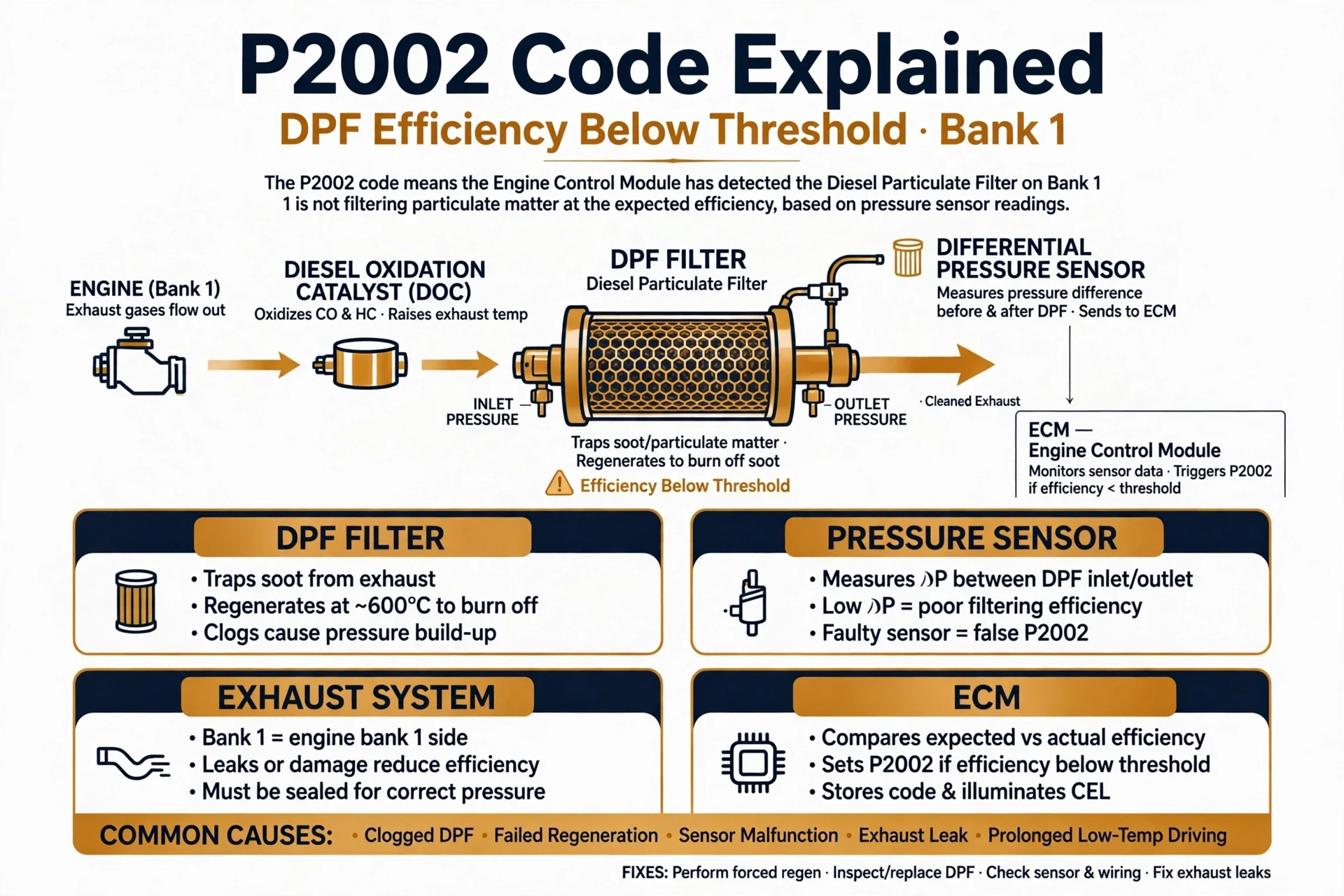
The P2002 code is a diesel-only trouble code that shows up when your truck or car’s computer decides the diesel particulate filter (DPF) is no longer trapping soot the way it should. Its full definition is “Diesel Particulate Filter Efficiency Below Threshold (Bank 1)” (p2002 diesel particulate filter efficiency below threshold bank 1). In plain English, the engine computer has watched the filter through one or more cleaning cycles and concluded it is not doing its job.
Here is how your vehicle figures this out. The computer cannot see inside the DPF, so it works from sensor data. A differential pressure sensor (also called the exhaust back pressure sensor) measures the pressure drop across the filter through two small steel lines, while exhaust gas temperature sensors report how hot the exhaust is getting. During a regeneration cycle, the computer burns off the trapped soot and expects to see the pressure readings fall back into a normal range. When the readings stay out of range, or the filter keeps failing to clean itself, the computer stores the P2002 code.
P2002 (p2002 obd ii, p2002 code bank 1) is a generic powertrain code, so it means the same thing on any diesel: a Ford Super Duty, a VW TDI, a Jeep EcoDiesel, or a Ram Cummins. Bank 1 simply refers to the first (and on most diesels, the only) bank of the engine. Its close relatives are P2000 and P2001, which flag the NOx trap instead of the particulate filter, and P2003, the same DPF fault for bank 2.
Symptoms of the P2002 Code
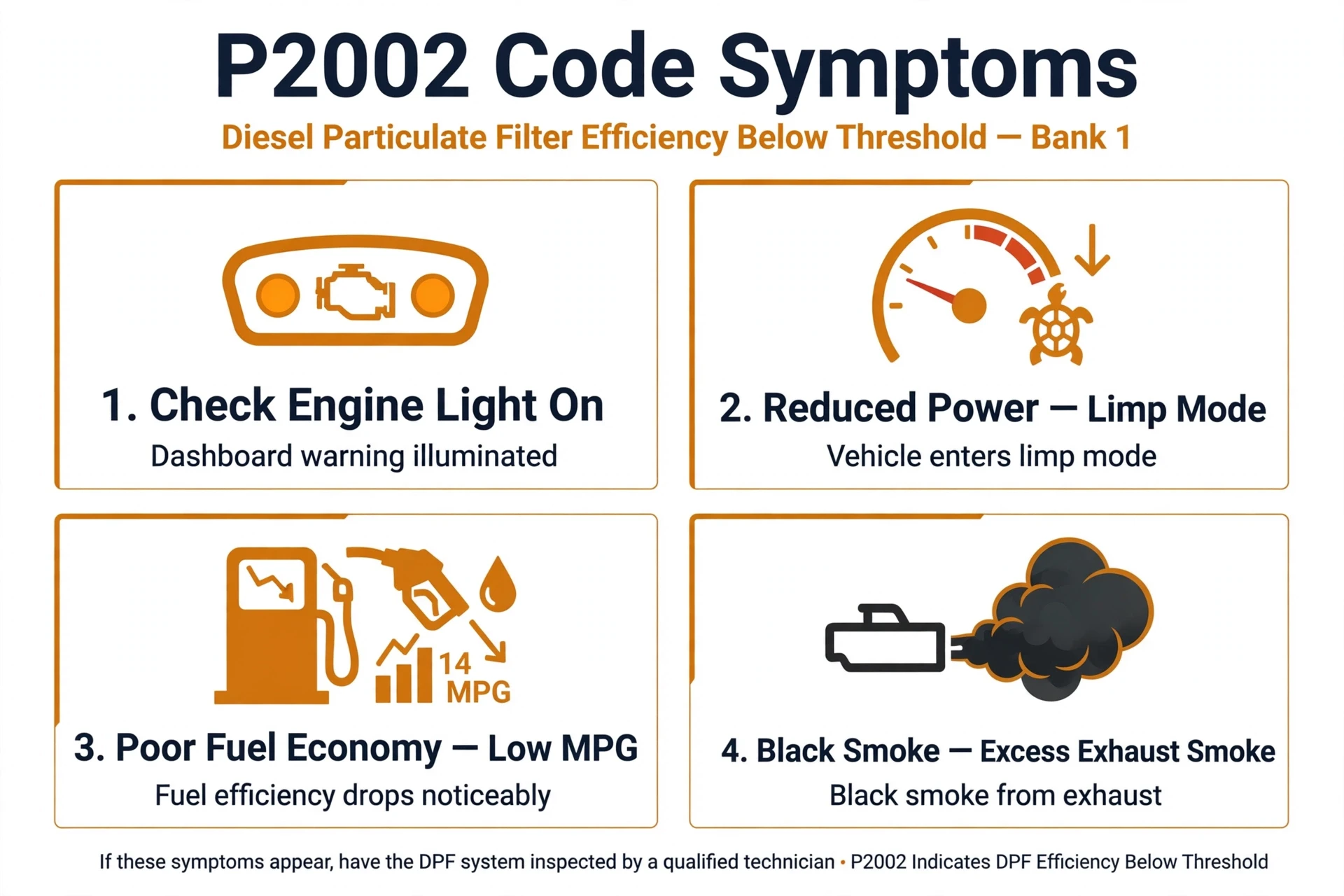
For many drivers, the check engine light is the first and sometimes the only sign. The vehicle may feel completely normal at first, which is why P2002 often gets ignored until it gets worse. Depending on how far the problem has gone, you might also notice:
- Check engine light on, sometimes joined by a DPF warning light
- Reduced engine power or limp mode on longer drives
- Worse fuel economy than usual
- Black soot around the tailpipe or inside the exhaust tip
- More frequent or failed DPF regeneration attempts
- Failed emissions test in states or countries that test diesels
What is code P2002 trying to tell you? In short: your diesel’s soot filter is not keeping up, either because it is overloaded, damaged, or the computer is getting bad sensor readings. A sooty tailpipe is a particularly telling clue, since a healthy DPF should leave the exhaust tip nearly clean.
Common Causes of P2002
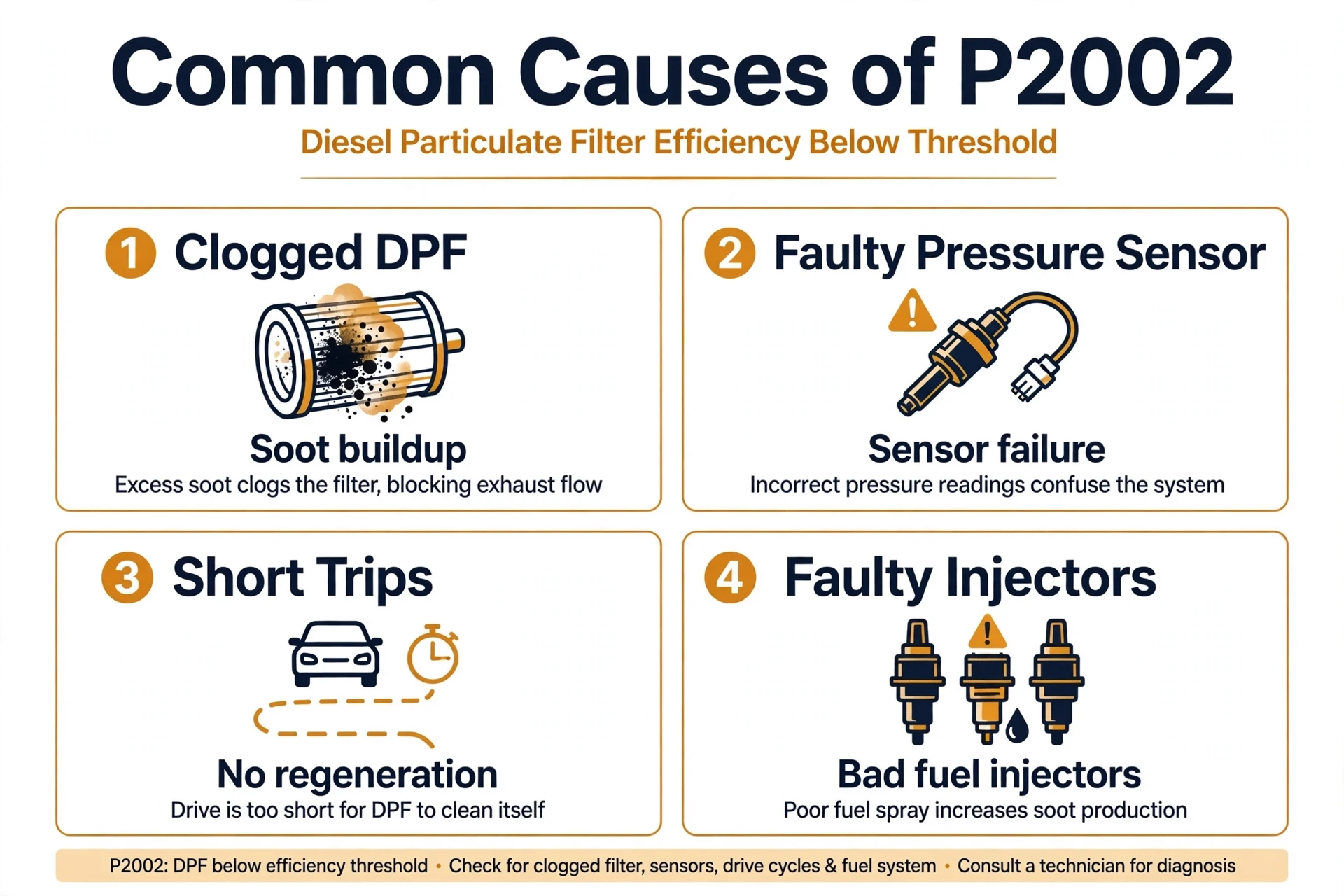
Most of the time, the P2002 code is telling the truth: the filter really is struggling. But a bad sensor can cry wolf too, and guessing wrong here is expensive. Here are the causes, roughly in order of likelihood:
- Clogged DPF from soot and ash buildup: the most common trigger. Frequent short trips and low-speed city driving never let the exhaust get hot enough for a full regeneration, so soot piles up until the filter chokes.
- Cracked or damaged DPF: thermal stress or physical damage inside the filter lets soot slip straight through the core. If your tailpipe is coated in black soot, the filter is likely cracked rather than just clogged.
- Faulty differential pressure sensor or blocked pressure lines: a dead sensor or a soot-clogged, melted, or cracked steel pressure line feeds the computer false readings, and it blames the filter.
- Exhaust leaks before or near the DPF: leaks change the pressure the sensor sees and can keep the filter from reaching regeneration temperature.
- Failed or interrupted regenerations: faulty exhaust gas temperature sensors, weak glow plugs, or a driving pattern of constant short hops can all stop regens from completing.
- Engine problems making excess soot: leaking fuel injectors, turbocharger issues, EGR faults, or using the wrong (high-ash) engine oil overload the filter faster than it can clean itself.
- DPF at the end of its service life: ash from burned oil never burns off, so even a healthy filter eventually fills with ash and needs professional cleaning or replacement.
How to Diagnose P2002 (Do This Before Buying Parts)
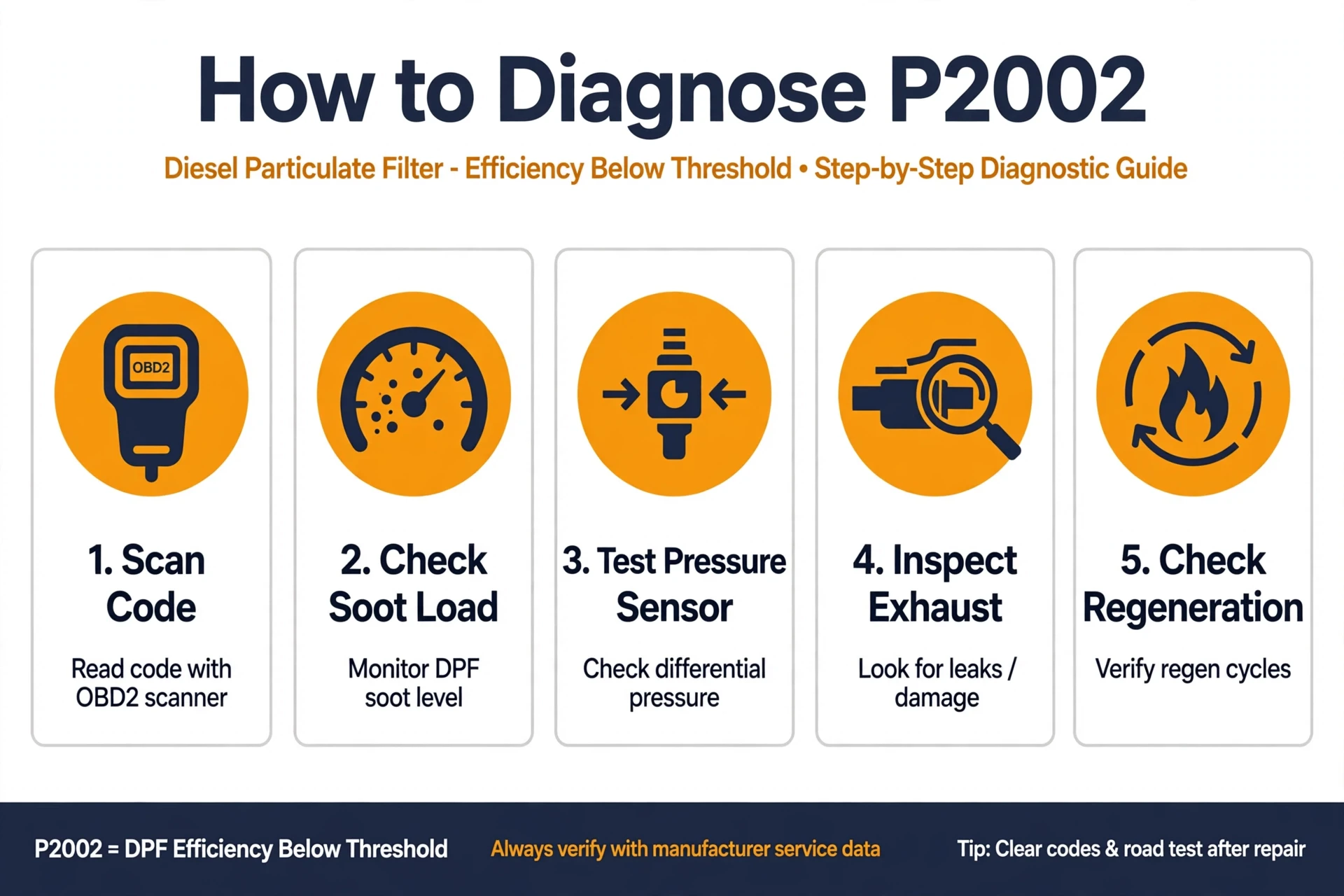
Mechanics see the P2002 code misdiagnosed constantly, usually as an automatic DPF replacement. The filter may be fine, the sensor may be lying, or the engine may just need a proper regen. Follow this order:
- Scan for companion codes first. DPF pressure sensor codes (P2452/P2453), soot accumulation codes (P2463), or EGT sensor faults point at the real problem and can clear the P2002 once fixed.
- Check live data. With a scanner that reads diesel PIDs, look at differential pressure across the DPF, soot mass, and exhaust gas temperatures. Sky-high pressure at idle suggests a clog; near-zero pressure with a sooty tailpipe suggests a cracked filter.
- Inspect the tailpipe. Wipe a finger inside the exhaust tip. Heavy black soot means particulate matter is slipping past the filter, which points to internal damage rather than a simple clog.
- Inspect the pressure sensor and lines. Follow the two steel lines from the DPF to the differential pressure sensor. Look for cracks, melted spots, soot blockages, and damaged wiring or connectors.
- Check for exhaust leaks and regen history. Look for leaks upstream of the DPF, and check whether the vehicle actually completes regenerations. A truck that only does short trips may just need a proper highway regen cycle before you condemn any parts.
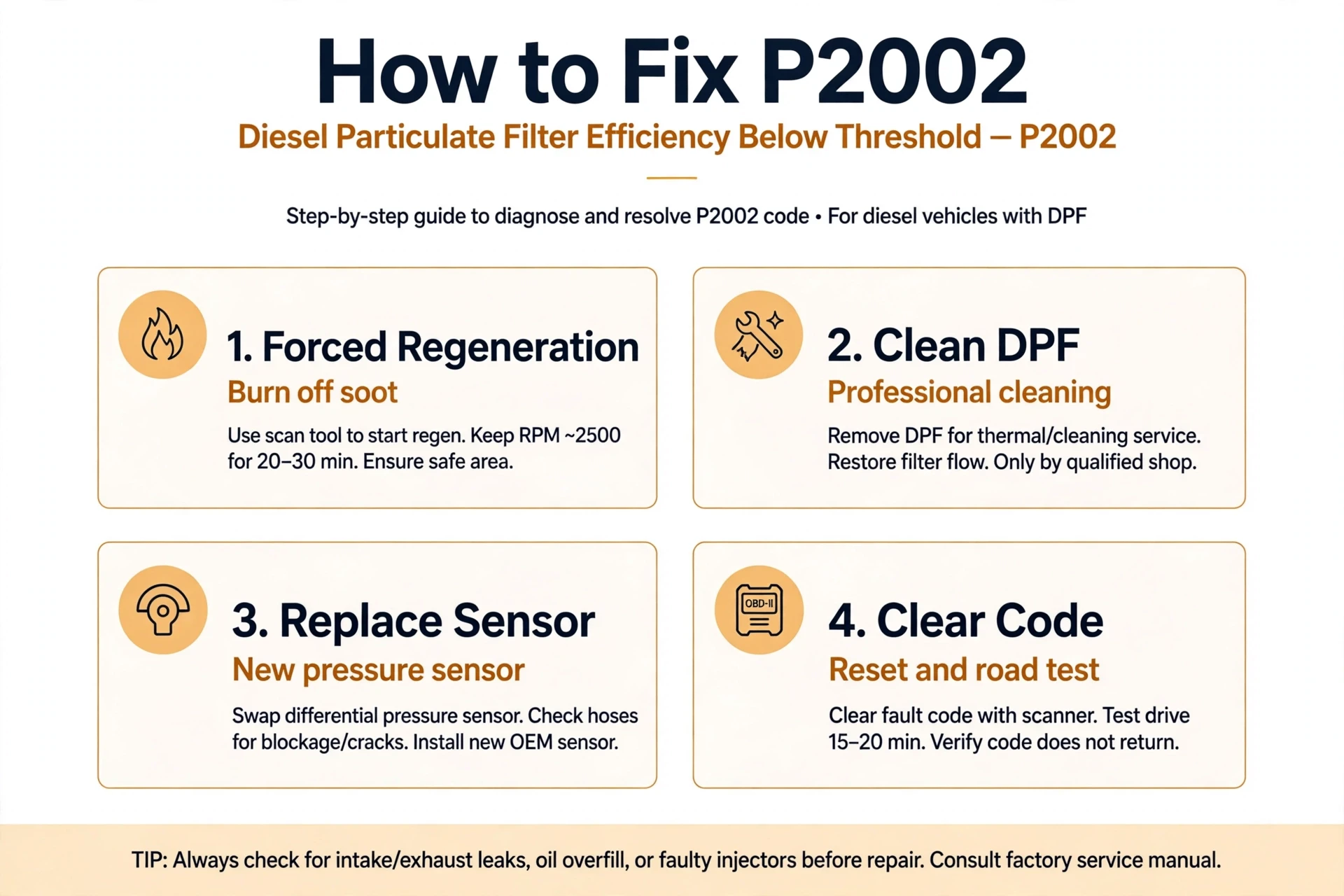
How to Fix the P2002 Code
The right fix depends on what your diagnosis found:
- Complete a regeneration: if the filter is simply overloaded with soot, a sustained highway drive (or a forced service regen with a capable scanner) can burn it off and clear the code. This is the cheapest fix when it works.
- Replace the differential pressure sensor or repair its lines: if the sensor is dead or the steel lines are blocked or cracked, new parts restore honest readings to the computer.
- Fix the root cause of excess soot: repair leaking injectors, turbo or EGR faults, and switch to the correct low-ash diesel engine oil so the filter is not overwhelmed again.
- Professional DPF cleaning: if the filter is intact but loaded with ash, an off-vehicle thermal or aqueous cleaning can restore it for far less than replacement.
- Replace the DPF: only after confirming the filter is cracked, melted, or permanently clogged. Reset the DPF adaptations and learned values with a scanner after fitting the new unit.
P2002 Repair Costs
Drivers always ask how much it costs to fix P2002, and the range is wide because a sensor and a filter share the same code. Here are realistic ranges:
| Repair | Cost Range |
|---|---|
| Diagnostic scan and regen attempt | $0 – $150 |
| Differential pressure sensor / line repair | $80 – $200 |
| Professional DPF cleaning | $200 – $500 |
| DPF replacement | $1,000 – $4,000+ |
This is why diagnosis matters. A $120 sensor job and a $3,000 DPF replacement share the same code. Start with the tailpipe check, the sensor lines, and a regen attempt before pricing a new filter.
DIY vs Mechanic Verdict
You can do this at home: reading the code and companion codes with an OBD2 scanner, the tailpipe soot check, inspecting the pressure sensor hoses and wiring for damage, and taking the vehicle for a sustained highway drive to let it complete a regen.
See a mechanic for: a forced service regeneration with a factory-level scan tool, DPF removal and professional cleaning, DPF replacement (which needs adaptations reset), and any electrical diagnosis on the sensor circuits.
Bottom line: do the easy checks and the highway regen yourself, but let a diesel shop handle the forced regen, the cleaning, and the filter swap.
Can You Drive With a P2002 Code?
Generally yes, for a short time. P2002 is often treated as a soft code, and the vehicle may drive normally at first. But do not ignore it for long: the filter keeps loading with soot, the computer may eventually cut power and drop you into limp mode, and repeated failed regens can overheat the exhaust or dilute the engine oil with diesel. If the light starts flashing or power drops, get it checked right away.
P2002 on Popular Vehicles
P2002 only shows up on diesels, but it crosses every brand that sells one:
- Ford (F-250/F-350 Super Duty 6.7L Powerstroke): the p2002 ford code often traces to a cracked DPF. Ford even published TSB 21-2332 about DPF cracking on some trucks, so check for the sooty tailpipe clue first.
- Volkswagen / Audi (2.0 TDI, Euro 6): on VAG diesels, P2002 sometimes appears alongside an ECU software glitch that points at the DPF unfairly. Make sure the engine software is up to date before replacing parts.
- Jeep Grand Cherokee EcoDiesel: the p2002 jeep code is a familiar sight on the 3.0L EcoDiesel, where short-trip driving keeps the DPF from completing regens.
- Chevy / GMC (Duramax 6.6L): the p2002 chevy code usually means a genuinely loaded filter on hard-worked trucks. A forced regen often sorts it if the filter is intact.
- Ram (Cummins 6.7L): the p2002 cummins code shows up on trucks that idle for long hours. Extended idling builds soot fast, so a working truck needs regular highway time.
- Suzuki Grand Vitara diesel: on the 1.9 DDiS, a split or perished differential pressure sensor hose is a classic cause, and it is a cheap fix.
No matter the brand, the diagnostic order stays the same: tailpipe check, sensor lines, live data, then the filter itself.
P2002 vs Related Codes
P2002 means the diesel particulate filter on bank 1 is underperforming. P2003 is the same fault for bank 2, seen on some V6/V8 diesels with two separate DPFs. P2000 and P2001 look similar but flag the NOx trap (lean NOx trap), a different part of the aftertreatment system that handles nitrogen oxides rather than soot. Fix the code you actually have: a DPF code needs DPF diagnosis, not NOx trap parts.
Related Codes
- P2003: Diesel Particulate Filter Efficiency Below Threshold (Bank 2)
- P2000 / P2001: NOx Trap Efficiency Below Threshold (Bank 1 / Bank 2), the aftertreatment neighbor of P2002
- P2452 / P2453: DPF Differential Pressure Sensor Circuit faults (a common root cause of P2002)
- P2463: DPF Soot Accumulation, the overload warning that often comes first
Video Walkthrough
Watch the video above for a visual walkthrough of P2002 causes and diagnosis before you read on.
Frequently Asked Questions
What is the most common cause of a P2002 code?
A clogged diesel particulate filter is the most common cause, usually from too much soot and ash after lots of short trips that prevent full regenerations. A cracked DPF and a faulty differential pressure sensor are the next most likely culprits.
Can you drive with a P2002 code?
Yes, for a short time. It is often treated as a soft code and the vehicle may feel normal. But driving on can push the vehicle into limp mode, and repeated failed regens can overheat the exhaust or dilute the engine oil, so get it diagnosed soon.
How do you fix the P2002 code?
Diagnose first: check companion codes, read the DPF differential pressure and soot data, do the tailpipe soot check, and inspect the sensor lines. Then fix what you find: complete a regen, replace a bad sensor or blocked lines, clean the DPF professionally, or replace the filter if it is cracked or permanently clogged.
Will a P2002 code clear itself?
Sometimes, after a successful regeneration burns off the excess soot. But if the root cause is still there, like a cracked filter or a dead sensor, the code comes right back. Many owners find highway drives alone do not clear it.
How much does it cost to fix P2002?
From about $80-$200 for a differential pressure sensor or line repair, $200-$500 for professional DPF cleaning, up to $1,000-$4,000+ for a full DPF replacement depending on the vehicle.
Can a bad pressure sensor cause P2002?
Yes. The computer judges the DPF by what the differential pressure sensor tells it. A dead sensor or a blocked, melted, or cracked pressure line feeds it false readings, and it sets P2002 even though the filter itself is fine. Always check the sensor and lines before replacing the DPF.
How do you unclog a diesel particulate filter?
Start with a sustained highway drive so the vehicle can complete a full regeneration. If that does not work, a shop can force a service regen with a scan tool. For heavy ash buildup, professional off-vehicle DPF cleaning is the next step. Avoiding constant short trips prevents it from clogging again.
Conclusion
The P2002 code looks scary, but it is really your diesel asking for a proper diagnosis, not an automatic DPF replacement. Check the tailpipe, inspect the sensor lines, read the live pressure data, and give it a real regen before you spend money. Do that, and you will either solve it cheaply or know for certain the filter is done. Either way, you stop guessing and start fixing.
About the author: Written by the OBD2 Code Hub editorial team. Our diagnostic guides are built from real OBD-II data, manufacturer service procedures, and hands-on troubleshooting experience, then reviewed for technical accuracy before publishing. We drive the same cars you do.