
P2463 Trouble Code: Meaning, Causes, Symptoms & Fixes
In This Guide
One-line meaning: P2463: Diesel Particulate Filter Restriction – Soot Accumulation.
What the P2463 Code Means
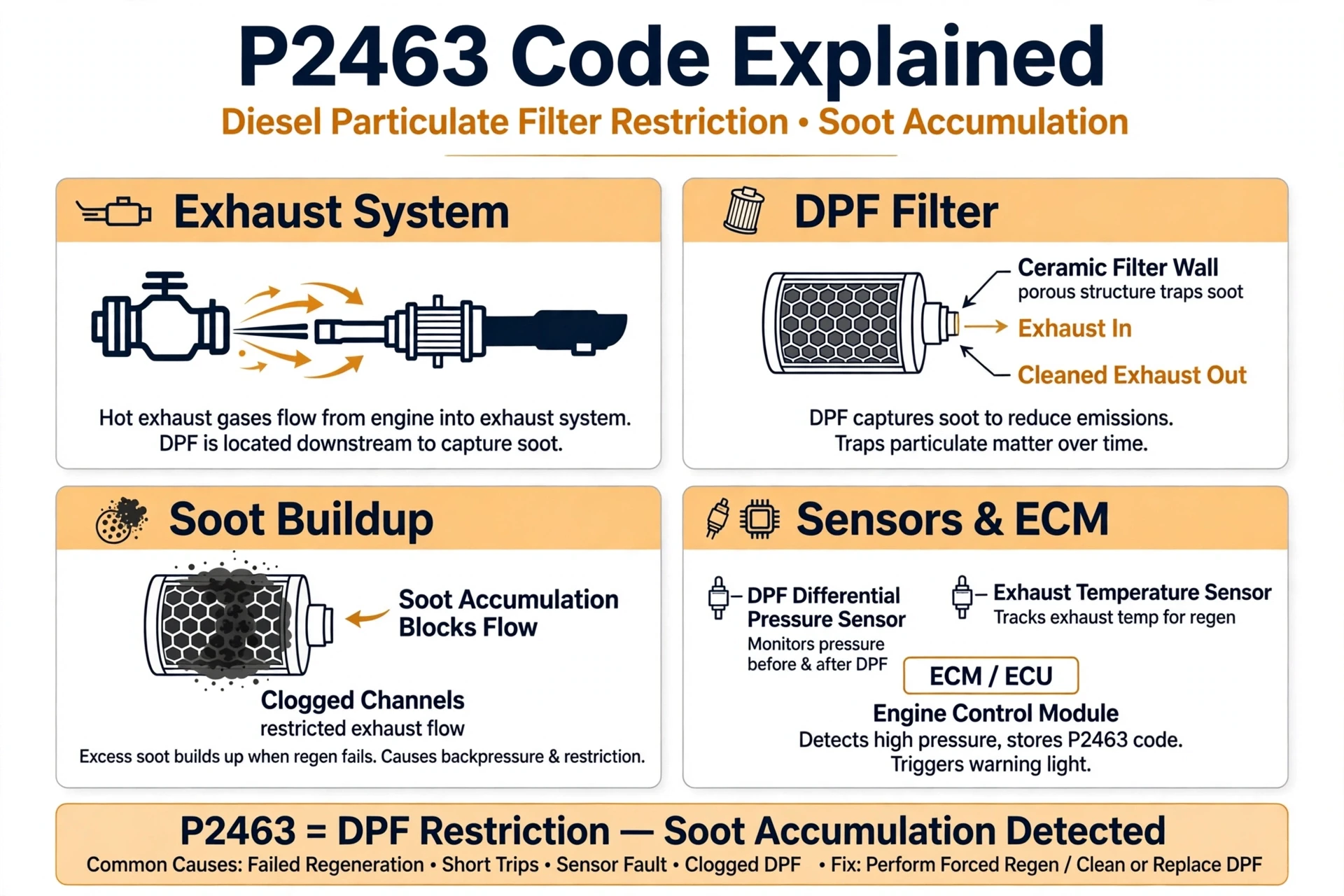
The p2463 code is a generic OBD-II trouble code that only appears on diesel engines. Its official definition is “Diesel Particulate Filter Restriction – Soot Accumulation.” In plain language, your truck or car’s computer has decided that the diesel particulate filter (DPF) is clogged with too much soot, or that exhaust back pressure is running higher than normal.
To understand p2463, it helps to know what the DPF does. The filter sits in the exhaust system and traps the black soot particles that diesel engines produce, removing around 90 percent of them from tailpipe emissions. As you drive, soot collects in the filter’s ceramic walls. The engine normally burns it off during regeneration, a self-cleaning cycle that uses high exhaust temperatures to turn soot into harmless ash and gas.
Your powertrain control module (PCM or ECU) watches this process through sensors mounted before and after the DPF, especially the DPF differential pressure sensor. When the pressure drop across the filter climbs past a set limit, meaning exhaust cannot flow freely through the soot-packed filter, the computer stores P2463 and lights the check engine light. On some scan tools the code appears with a Bank 1 label, which simply reflects the single DPF on most diesel exhaust systems.
Symptoms of the P2463 Code
A DPF that is packed with soot affects the whole engine. Here are the symptoms drivers report most often with the p2463 code:
- Check engine light or DPF warning light: the light stays on, and a DPF or service message may appear on the dashboard.
- Limp mode and reduced power: the computer limits performance to protect the engine and exhaust, and the vehicle may struggle to build or hold RPM.
- Increased fuel consumption: the engine works harder to push exhaust through the restricted filter and may run extra regeneration attempts.
- Black smoke from the exhaust: excess soot can escape as dark smoke, especially under load.
- High exhaust or engine temperatures: the DPF housing and nearby exhaust parts can run hotter than normal.
- Other DPF-related codes: companion codes such as P2002, P2459, or P2453 may appear alongside P2463.

Common Causes of P2463
Soot is normal, but it should burn off during regeneration. P2463 appears when something lets soot win the race. The most common causes are:
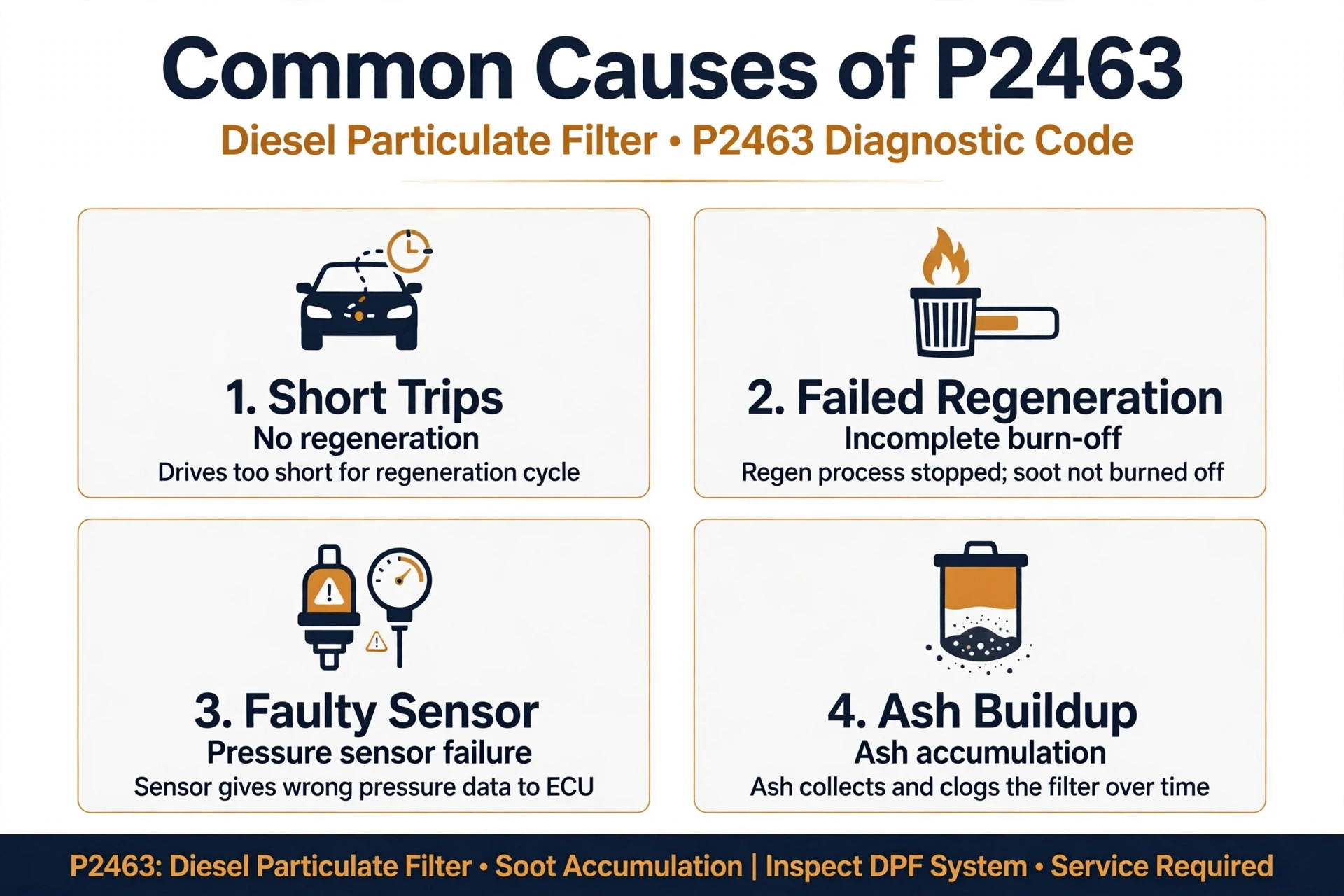
- Frequent short trips and stop-and-go driving: the engine never gets hot enough or runs long enough for a complete regeneration, so soot piles up faster than it burns away.
- Failed or interrupted regeneration: a low fuel level can keep a regen from starting, while sensor faults or cut-short drive cycles can leave a cleaning cycle half finished.
- Faulty DPF differential pressure sensor: the sensor misreads the pressure across the filter, and the computer concludes the DPF is clogged even when it is not.
- Clogged or damaged sensor hoses and wiring: the small rubber and metal pressure lines to the sensor can crack, melt, or plug with soot, and damaged wiring corrupts the signal.
- EGR valve or wiring problems: a sticking EGR valve raises soot output, which loads the DPF faster than regeneration can handle.
- Low, wrong, or contaminated diesel exhaust fluid (DEF): on SCR-equipped trucks, DEF issues can disturb the exhaust treatment chain and accompany DPF faults.
- Clogged DPF or ash buildup: a filter that has survived many regens can fill with ash that no regen can burn off, leaving little room for fresh soot.
- Faulty exhaust temperature sensor or PCM software issue: wrong temperature readings can prevent regen from starting, and outdated PCM software can set the code in error.
How to Diagnose P2463 (Do This Before Buying Parts)
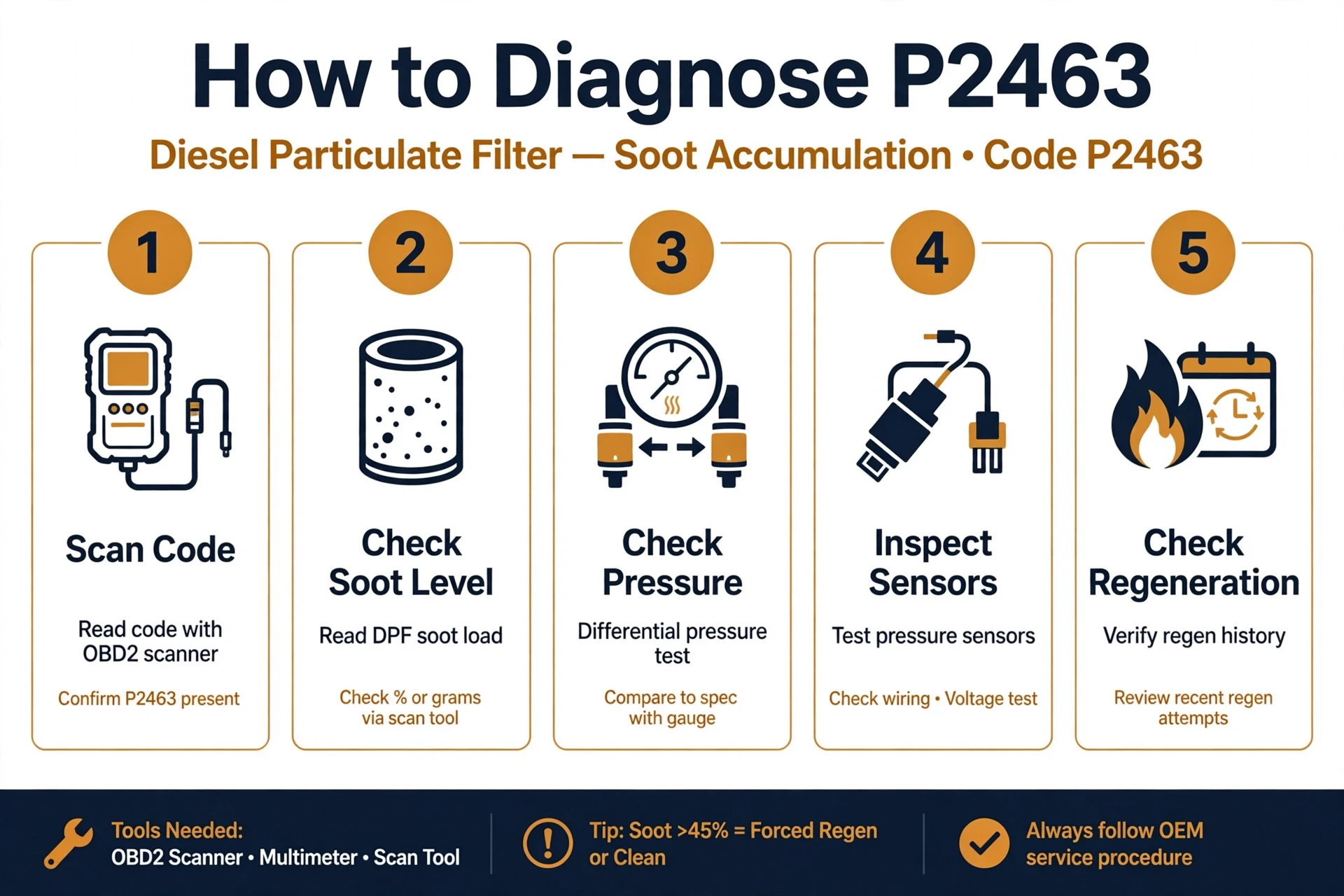
Do not buy parts yet. Work through these checks in order, because the fix is often a hose or a sensor rather than a filter:
- Scan for all codes and check technical service bulletins (TSBs). Fix companion codes first, since they can trigger or mimic P2463.
- Read the freeze frame data to see the engine conditions when the code was set.
- Inspect the DPF sensor wiring, connectors, and pressure hoses for cracks, melting, blockages, and loose connections. These small lines are a very common failure point.
- Check the DPF differential pressure sensor readings with a scan tool or multimeter, comparing the values before and after the DPF against the manufacturer’s specifications.
- Review live data: soot load, exhaust back pressure, and exhaust temperature. Note whether a regeneration has been attempted recently and whether it completed.
- Check the diesel exhaust fluid level and condition if your vehicle uses DEF.
- Command a manual regeneration with a scan tool if the sensor readings look normal and the soot load is within limits, and watch the values respond.
How to Fix the P2463 Code
The right fix depends on what the diagnosis found. Work from the cheapest repair upward:
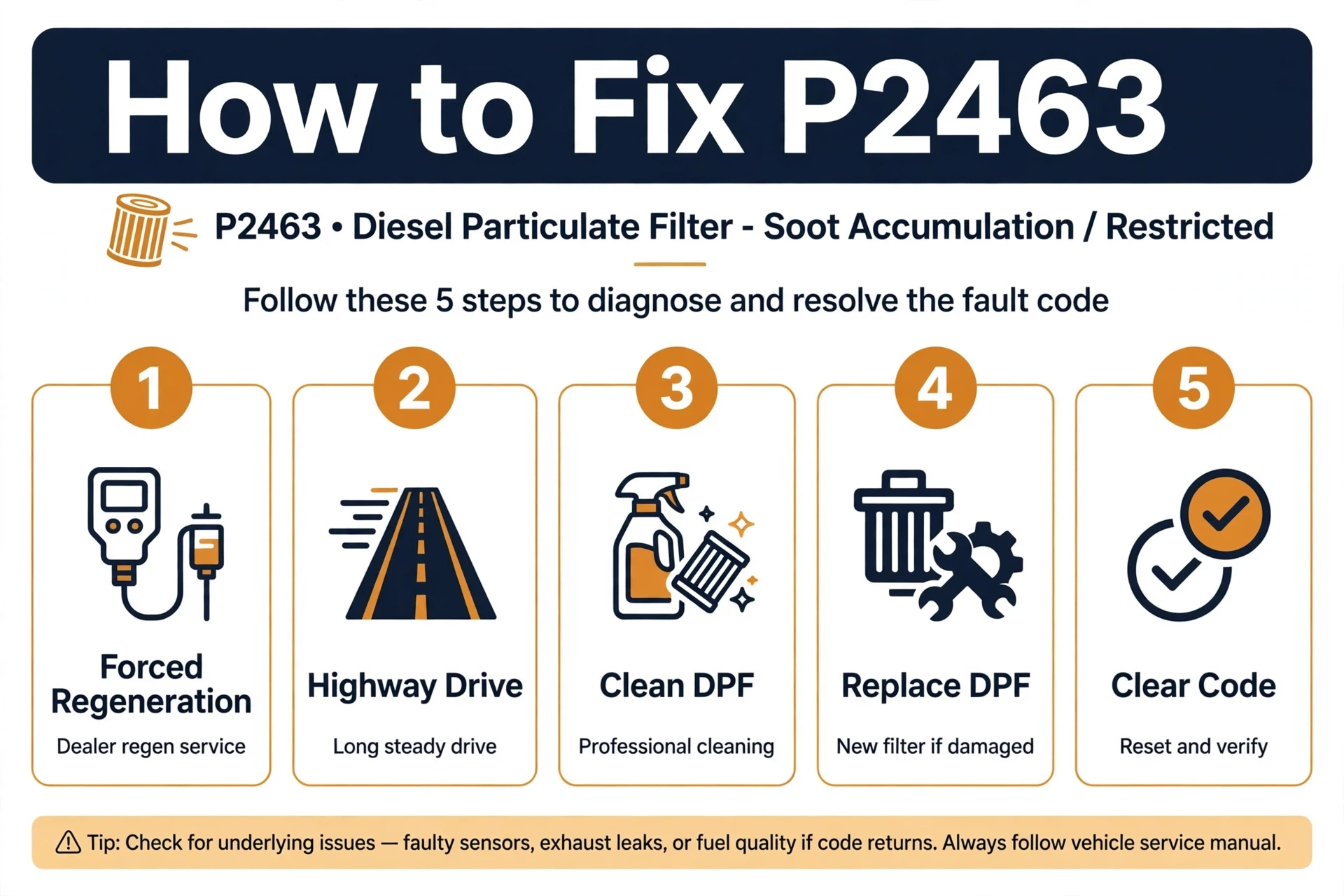
- Repair damaged wiring and replace clogged or cracked DPF pressure sensor hoses.
- Replace a faulty DPF differential pressure sensor (usually $65 – $190 for the part).
- Perform a forced regeneration with a scan tool when soot levels permit it.
- Have the DPF professionally cleaned off the vehicle (chemical or thermal cleaning) when the filter is heavily sooted but still sound.
- Replace the DPF when it is cracked, melted, or loaded with ash beyond cleaning.
- Fix the root cause: service or replace a sticking EGR valve, replace a bad exhaust temperature sensor, top up or correct the DEF, or apply a PCM software update.
- Clear the codes, then take the vehicle for a proper drive and recheck for pending codes.
P2463 Repair Costs
| Repair | Typical Cost |
|---|---|
| OBD-II diagnostic scan | $75 – $150 |
| DPF differential pressure sensor replacement | $65 – $190 |
| Forced DPF regeneration (shop) | $100 – $300 |
| Professional off-car DPF cleaning | $300 – $650 |
| EGR valve replacement | $200 – $600 |
| DPF replacement | $1,500+ |
DIY vs Mechanic Verdict
You can do this at home: reading the code, checking freeze frame data, inspecting sensor hoses and wiring, checking the DEF level, and taking the truck for a long steady highway drive to help a regeneration complete.
See a mechanic for: a forced regeneration with a scan tool, sensor replacement under the vehicle, off-car DPF cleaning, DPF replacement, and any EGR or exhaust work.
Bottom line: if you are comfortable with basic checks and your scan tool shows soot load dropping during a highway drive, DIY diagnosis is reasonable. If the filter is heavily clogged, the truck is in limp mode, or a forced regen is needed, let a diesel shop handle it.
Can You Drive With a P2463 Code?
You can usually drive a short distance, such as to a repair shop or on a steady highway run that lets a regeneration finish. Do not keep driving for weeks with the code active. A restricted DPF gets worse with time: back pressure climbs, fuel economy drops, the truck can drop into a deeper limp mode, and heat and pressure can damage the turbo, sensors, and exhaust components. Treat P2463 as a fix-it-soon warning, not a stop-the-truck emergency, unless power loss makes the truck unsafe to drive.
P2463 on Popular Vehicles
P2463 only affects diesels, and it shows up on just about any modern diesel fitted with a DPF. It is most often reported on:
- Ford Super Duty trucks with the 6.7L Power Stroke diesel
- Ram 2500 and 3500 trucks with the 6.7L Cummins diesel
- Chevrolet Silverado and GMC Sierra trucks with the 6.6L Duramax diesel
- Toyota Hilux and Land Cruiser diesels
- Volkswagen TDI diesel models
Work trucks, tow rigs, and delivery vans that spend their lives on short trips and idling are the most frequent visitors for this code, because they rarely get the long hot runs a DPF needs to clean itself.
P2463 vs Related Codes
- P2463: the DPF is restricted right now because of soot accumulation.
- P2002: the DPF’s filtering efficiency has dropped below its threshold.
- P2459: the regeneration frequency is off, too many or failed regen attempts.
- P24A4: the calculated soot accumulation has passed a set limit.
Related Codes
- P2002: Diesel Particulate Filter Efficiency Below Threshold
- P2453: DPF Pressure Sensor A Circuit Range/Performance
- P244B: DPF Differential Pressure Too High
- P2459: DPF Regeneration Frequency
- P24A4: Particulate Matter Accumulation Too High
Video Walkthrough
Watch the video above for a visual walkthrough of P2463 causes and fixes before you read on.
Frequently Asked Questions
What does the P2463 code mean?
P2463 means Diesel Particulate Filter Restriction – Soot Accumulation. The computer has detected that the DPF is clogged with soot or that exhaust back pressure is higher than normal. It is a diesel-only code.
How do you fix the P2463 code?
Start with diagnosis: scan for companion codes, inspect the DPF sensor hoses and wiring, and read the differential pressure sensor values. The fix may be as simple as a forced regeneration, a new pressure sensor, or repaired hoses. A heavily clogged filter needs professional cleaning or replacement.
Can I drive with a P2463 code?
Short trips to a shop or a steady highway drive to complete a regeneration are usually fine, but do not ignore the code for long. Continued driving with a restricted DPF raises back pressure, hurts fuel economy, and can damage the turbo, sensors, and exhaust components.
Will the P2463 code clear itself?
It can clear after a successful regeneration cycle removes enough soot, but the code usually returns if the root cause is not fixed. Clear the code only after the repair, then confirm it stays off with a test drive.
Can a bad DPF pressure sensor cause P2463?
Yes. A faulty DPF differential pressure sensor, or clogged, cracked, or melted sensor hoses, can report false high pressure and trigger P2463 even when the filter itself is fine. Always test the sensor and hoses before replacing the DPF.
What is the most common cause of P2463?
Short-distance and stop-and-go driving that never lets the engine complete a regeneration. Failed or interrupted regen cycles, low fuel levels that block regen, and faulty pressure sensors or hoses are the next most common causes.
How much does it cost to fix a P2463 code?
A differential pressure sensor replacement runs about $65 – $190, professional DPF cleaning runs $300 – $650, and a full DPF replacement starts around $1,500. A shop diagnostic scan usually costs $75 – $150.
Conclusion
The p2463 code is your diesel’s way of saying its particulate filter is choked with soot. In many cases the cure is simple: finish a regeneration, fix a cracked sensor hose, or replace a faulty pressure sensor. Start with diagnosis, not parts, and only replace the DPF when cleaning and regen have failed. Catch it early and this code is a maintenance story, not a disaster.
About the author: Written by the OBD2 Code Hub editorial team. Our diagnostic guides are built from real OBD-II data, manufacturer service procedures, and hands-on troubleshooting experience, then reviewed for technical accuracy before publishing. We drive the same cars you do.