
P0340 Trouble Code: Meaning, Causes, Symptoms & Fixes
In This Guide
One-line meaning: P0340: Camshaft Position Sensor Circuit Malfunction.
What the P0340 Code Means
The P0340 code is a check engine light code that confuses a lot of drivers, because its name sounds like one bad part you just swap out. Its full definition is “Camshaft Position Sensor ‘A’ Circuit Malfunction (Bank 1 or Single Sensor)” (p0340 camshaft position sensor a circuit bank 1). In plain English, your car’s engine computer (ECM/PCM) is not getting the electrical signal it expects from the camshaft position sensor, so it cannot confirm where the camshaft is.
Here is what that sensor does all day. The camshaft position sensor tracks the rotation speed and exact position of the camshaft and reports it to the computer, which uses the signal to time fuel injection and spark. Bank 1 is the side of the engine that holds cylinder number one, and on engines with a single cam sensor, “Bank 1 or Single Sensor” simply means that one sensor. The “A” tags the intake-side sensor circuit on engines that run more than one camshaft sensor.
P0340 (p0340 obd ii, engine code p0340) is a generic powertrain code, which means it carries the same meaning on every make and model, from a Honda Civic to a Ford F-150 to a Nissan Altima. And here is the point most people miss: “circuit malfunction” does not automatically mean the sensor is dead. The break can sit anywhere in the circuit, in the wiring, the connector, the reference voltage, or even the mechanical parts the sensor reads.

Symptoms of the P0340 Code
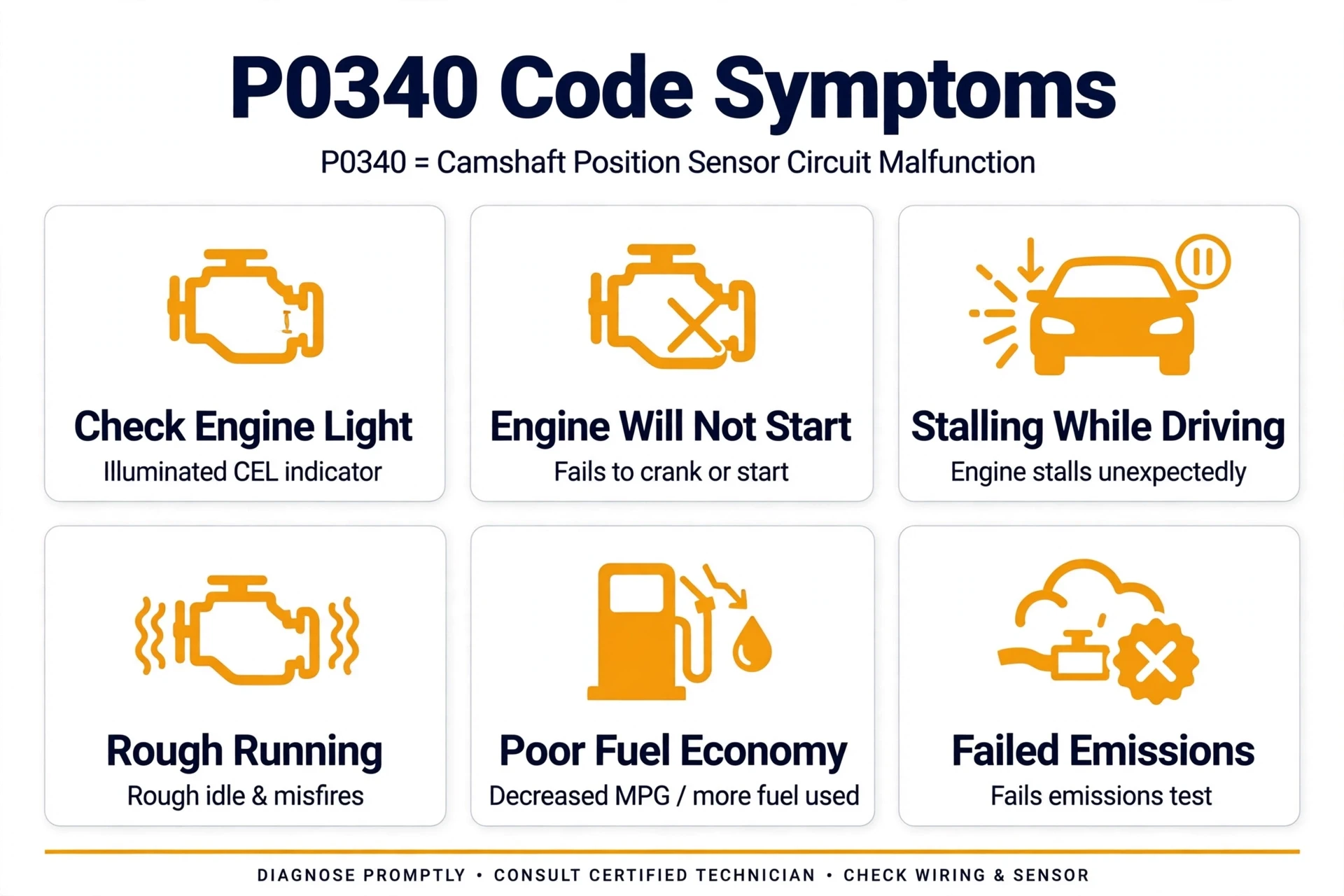
Unlike some codes that hide quietly, P0340 usually makes itself felt. When the computer loses track of camshaft position, fuel and spark timing drift, and the engine tells you about it. Watch for:
- Check engine light, steady or flashing
- Hard starting, extended cranking, or an engine that cranks but will not start
- Engine stalling or dying while driving
- Rough or shaking idle
- Hesitation, bucking, or stumbling when you accelerate
- Noticeable loss of power
- Poor fuel economy, often up to about 10% worse than normal
- Limp mode, where the computer caps power to protect the engine
What is code P0340 trying to tell you? In short: the computer has lost a signal it needs to run the engine correctly. Take it seriously, because a stall at speed is a safety problem, not just an annoyance.
Common Causes of P0340
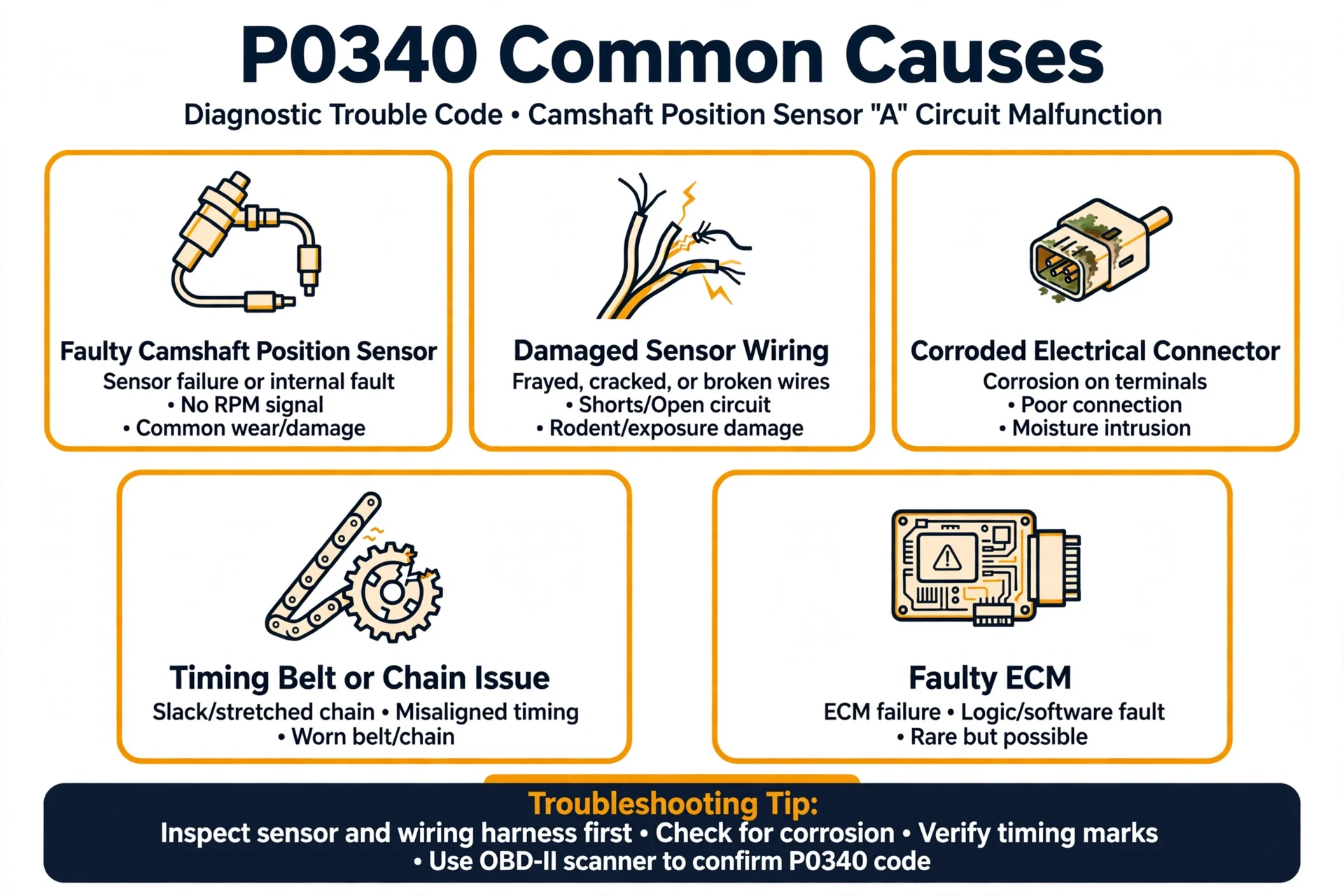
The most common cause of a P0340 code is damage in the sensor’s wiring or connector, not the sensor itself. Swapping the sensor without checking the circuit is the most expensive mistake drivers make with this code. Here are the causes, roughly in order of likelihood:
- Damaged wiring or connectors: chafed, cut, melted, or oil-soaked wires, loose plugs, broken locking tabs, bent pins, or green corrosion inside the connector. Heat and vibration wear harnesses out over time.
- Failed camshaft position sensor: internal wear or contamination can turn its signal weak, noisy, or intermittent.
- Timing belt or chain problems: a stretched chain, a skipped belt tooth, or a weak tensioner throws the camshaft out of sync with the crankshaft, and the computer flags the mismatch.
- Low or noisy system voltage: a weak battery, a failing alternator, or a bad voltage regulator can corrupt the sensor’s 5-volt reference signal. This one surprises people, but it is well documented.
- Damaged reluctor (trigger) wheel: the toothed wheel the sensor reads can crack, or pick up metal debris that distorts the signal.
- Blown fuse: on some vehicles the sensor feed is fused, and a blown fuse kills the whole circuit.
- Failed ECM/PCM or corrupt software: rare, but a module that can no longer read the signal, or firmware that needs an update, will set the code.
How to Diagnose P0340 (Do This Before Buying Parts)
Start with the question good technicians ask first: what changed right before the code appeared? Recent timing belt work, an engine swap, harness repairs, or even a battery replacement can point straight at the cause. Then work through this order:
- Scan for companion codes. P0335 (crankshaft sensor circuit), P0341 (cam sensor range/performance), or cam timing codes like P0010 change the picture. Chase shared causes first.
- Do a visual inspection. Find the camshaft position sensor, usually near the timing cover or cylinder head, and trace its harness. Look for chafing, melted spots, oil contamination, and a connector that does not click home. Try a wiggle test on the connector with the engine running.
- Check battery and charging voltage. A weak battery or an alternator putting out noisy voltage can set this code on its own. Confirm clean, stable system voltage before condemning any parts.
- Test the sensor circuit with a multimeter. With the key on, verify the 5-volt reference feed and a solid ground at the sensor connector, using your vehicle’s service data for the pinout. Then check the signal wire for the expected pulsing output while cranking.
- Watch live data. On a scanner with live data, the cam sensor signal should show a clean, steady pulse pattern that tracks RPM. A flat, erratic, or dropping signal points at the sensor or its wiring.
- Inspect mechanical timing. If the electrical side tests clean, verify the timing belt or chain has not jumped a tooth, and check the reluctor wheel for cracks or debris.
- Consider the computer last. If wiring, sensor, timing, and voltage all check out, an ECM software update or, rarely, module replacement is the final step.

How to Fix the P0340 Code
The right fix follows the diagnosis:
- Repair damaged wiring: cut out chafed sections, solder and heat-shrink the splices, and replace any harness run that is melted or oil-soaked.
- Service the connector: clean out corrosion, straighten bent pins, replace a plug with a broken lock, and pack it with dielectric grease to keep moisture out.
- Replace the camshaft position sensor: only after the circuit tests point at it. Buy a quality sensor, since cheap ones are a known source of repeat codes.
- Fix timing components: replace a stretched chain, a skipped belt, or a weak tensioner, and re-time the engine to spec.
- Restore system voltage: replace a weak battery or a failing alternator/voltage regulator so the sensor gets clean, stable power.
- Service the reluctor wheel: clear metal debris or replace the trigger wheel if it is cracked or damaged.
- Reflash or replace the ECM: the last resort, and a replacement module must be programmed to your vehicle.
- Clear the code and road test: after the repair, clear the code, drive through a full warm-up cycle, and confirm it does not return.

P0340 Repair Costs
What you pay for a P0340 fix depends entirely on which cause you find. Here are realistic ranges:
| Repair | Cost Range |
|---|---|
| Connector cleaning / wiring repair | $50 – $150 |
| Camshaft position sensor replacement | $150 – $350 |
| Battery replacement | $150 – $250 |
| Alternator replacement | $350 – $700 |
| Timing belt / chain service | $500 – $1,500+ |
| ECM reprogramming | $120 – $200 |
| ECM replacement (programmed) | $1,000 – $1,500+ |
This is why the wiring check comes first. A $75 connector repair and a $1,200 timing job share the same code, and guessing wrong gets expensive fast.
DIY vs Mechanic Verdict
You can do this at home: reading and clearing codes with an OBD2 scanner, visual inspection of the harness and connector, cleaning corrosion, testing battery voltage with a multimeter, and replacing the camshaft position sensor itself, which is often one bolt and one plug in an accessible spot.
See a mechanic for: timing belt or chain service (precision internal engine work), ECM reprogramming or replacement, chasing intermittent wiring faults buried deep in the harness, and any diagnosis that stays unclear after the basic checks. A shop can also scope the sensor signal to confirm a diagnosis in minutes.
Bottom line: inspect and test it yourself, fix the simple electrical stuff yourself, and hand the timing work to a pro.
Can You Drive With a P0340 Code?
Short distances, to reach a shop, usually. But this is not a code to commute on. The engine can stall without warning, refuse to restart, or drop into limp mode in traffic, which is a genuine safety risk. The honest guidance from parts professionals is blunt: driving is not recommended, because running with bad timing data can turn a wiring fault into bigger engine damage. Get it diagnosed promptly, and stay off highways until it is fixed.
P0340 on Popular Vehicles
P0340 is a generic code, but some patterns are worth knowing:
- Nissan (Altima, Sentra, Rogue): The p0340 nissan code (nissan p0340, p0340 code nissan) is common; start with the sensor connector and harness, which sit in a hot, tight spot on many Nissan engines.
- Honda (Accord, Civic, CR-V, Element): The p0340 honda code (honda p0340, p0340 code honda) often traces to a stretched timing chain on high-mileage engines, so verify mechanical timing if the wiring looks clean.
- Toyota (Camry, Corolla, RAV4): The p0340 toyota code (toyota p0340, p0340 code toyota) is frequently the sensor itself or its connector, and Toyota sensors are straightforward to test with a multimeter.
- Ford (F-150, Mustang, Explorer): The p0340 ford code (ford p0340, p0340 code ford) can follow alternator or battery trouble, so check system voltage early on Fords.
- Chevy (Silverado, Malibu, Equinox): The p0340 chevy code (chevy p0340, p0340 code chevy) sometimes arrives with crankshaft sensor codes, so test both circuits together.
- Jeep (Wrangler TJ 4.0L): The p0340 jeep code is well documented on the 4.0L inline-six; the cam sensor in the distributor drive and its wiring are the usual suspects.
- Subaru (Forester, Impreza, WRX): The p0340 subaru code (subaru p0340) often comes down to harness damage or a connector left loose after timing belt service, which is exactly why wiring-first diagnosis fits Subarus so well.
EOBD P0340 and OBD P0340 are the same code under different naming (European vs generic OBD-II). DTC P0340 and OBD-II P0340 refer to the identical fault.
P0340 vs P0341
P0340 means the circuit signal is missing or electrically broken. P0341, “Camshaft Position Sensor ‘A’ Circuit Range/Performance,” means a signal is present but implausible, for example the cam timing the computer calculates does not match what it expects to see. Think of P0340 as “no usable signal” and P0341 as “a signal that does not make sense.” P0340 leans electrical (wiring, connector, power), while P0341 leans mechanical (timing off, stretched chain). Diagnose them the same way, but weight your suspects accordingly.
Related Codes
- P0341: Camshaft Position Sensor “A” Circuit Range/Performance (Bank 1)
- P0335: Crankshaft Position Sensor “A” Circuit Malfunction (the crankshaft counterpart)
- P0342 / P0343: Camshaft Position Sensor “A” Circuit Low / High Input (Bank 1)
- P0010: “A” Camshaft Position Actuator Circuit (a common timing-related companion)
Video Walkthrough
Watch the video above for a hands-on look at camshaft position sensor replacement, the most common physical repair behind a P0340 code, before you read on.
Frequently Asked Questions
What is the most common cause of a P0340 code?
Damaged wiring or a bad connector at the camshaft position sensor. The harness lives in a hot, vibrating part of the engine bay, so chafed wires, corrosion, and loose plugs beat out actual sensor failures. Always inspect the circuit before buying a sensor.
Can I still drive my car with a P0340 code?
Only as far as a repair shop. The engine may stall, refuse to restart, or enter limp mode without warning, which is dangerous in traffic. Have it towed or drive it straight to a shop, and stay off highways.
How do you fix the code P0340?
Diagnose in order: check for companion codes, visually inspect the wiring and connector, verify battery and charging voltage, test the sensor’s 5-volt reference, ground, and signal with a multimeter, then check mechanical timing. Repair what you find: wiring, connector, sensor, timing parts, or charging system.
How much does it cost to fix P0340?
A wiring or connector repair runs about $50-$150, and a camshaft position sensor replacement about $150-$350. If the cause is a timing chain or belt, expect $500-$1,500+, and a programmed ECM replacement can exceed $1,000.
Will P0340 clear itself?
Rarely, and only if the fault was a one-time glitch. Because the computer re-tests the circuit continuously, the code almost always returns until the wiring, sensor, timing, or voltage problem is actually fixed.
Can a bad battery or alternator cause P0340?
Yes. The sensor runs on a precise 5-volt reference, and a weak battery or a failing alternator or voltage regulator can make that voltage sag or turn noisy, which the computer reads as a circuit malfunction. Test system voltage early in your diagnosis.
Should I just replace the camshaft position sensor?
Not first. The code means “circuit malfunction,” not “bad sensor,” and wiring or connector damage is the more common cause. Check the harness, connector, and voltage first, and replace the sensor only when testing points at it, or you risk buying a part you did not need.
Conclusion
The P0340 code looks like a parts order, but it is really a detective assignment. The computer is telling you it lost the camshaft signal, and the break is usually in the wiring or the connector, not the sensor itself. Inspect first, test second, replace last. Do that, and you will either fix it for the price of a connector repair or know for certain that the sensor, the timing set, or the charging system needs attention.
About the author: Written by the OBD2 Code Hub editorial team. Our diagnostic guides are built from real OBD-II data, manufacturer service procedures, and hands-on troubleshooting experience, then reviewed for technical accuracy before publishing. We drive the same cars you do.