
P0335 Trouble Code: Meaning, Causes, Symptoms & Fixes
In This Guide
One-line meaning: P0335: Crankshaft Position Sensor Circuit Malfunction.
What the P0335 Code Means
The P0335 code is a generic powertrain code with the official definition “Crankshaft Position Sensor ‘A’ Circuit Malfunction” (p0335 crankshaft position sensor circuit malfunction). In plain English, your car’s engine computer (ECM or PCM) has lost the signal from the crankshaft position sensor, or the signal it is receiving does not make sense.
The crankshaft position sensor is one of the most important inputs your engine computer has. It watches a toothed wheel called the reluctor ring as the crankshaft spins, and from that it works out exactly where the crankshaft is and how fast it is turning. The computer needs that information to time fuel injection and ignition correctly. Without it, the engine cannot run properly, and in many cases it will not run at all.
The “A” in the definition points to the primary crankshaft sensor circuit on vehicles that use more than one crankshaft sensor. The p0335 code is a circuit code, not strictly a sensor code, and that distinction matters. The fault can be the sensor itself, but it can just as easily be damaged wiring, a corroded connector, a cracked reluctor ring, or in rare cases the computer itself. Swapping the sensor without checking the circuit first is the most common misdiagnosis with this code.

Symptoms of the P0335 Code
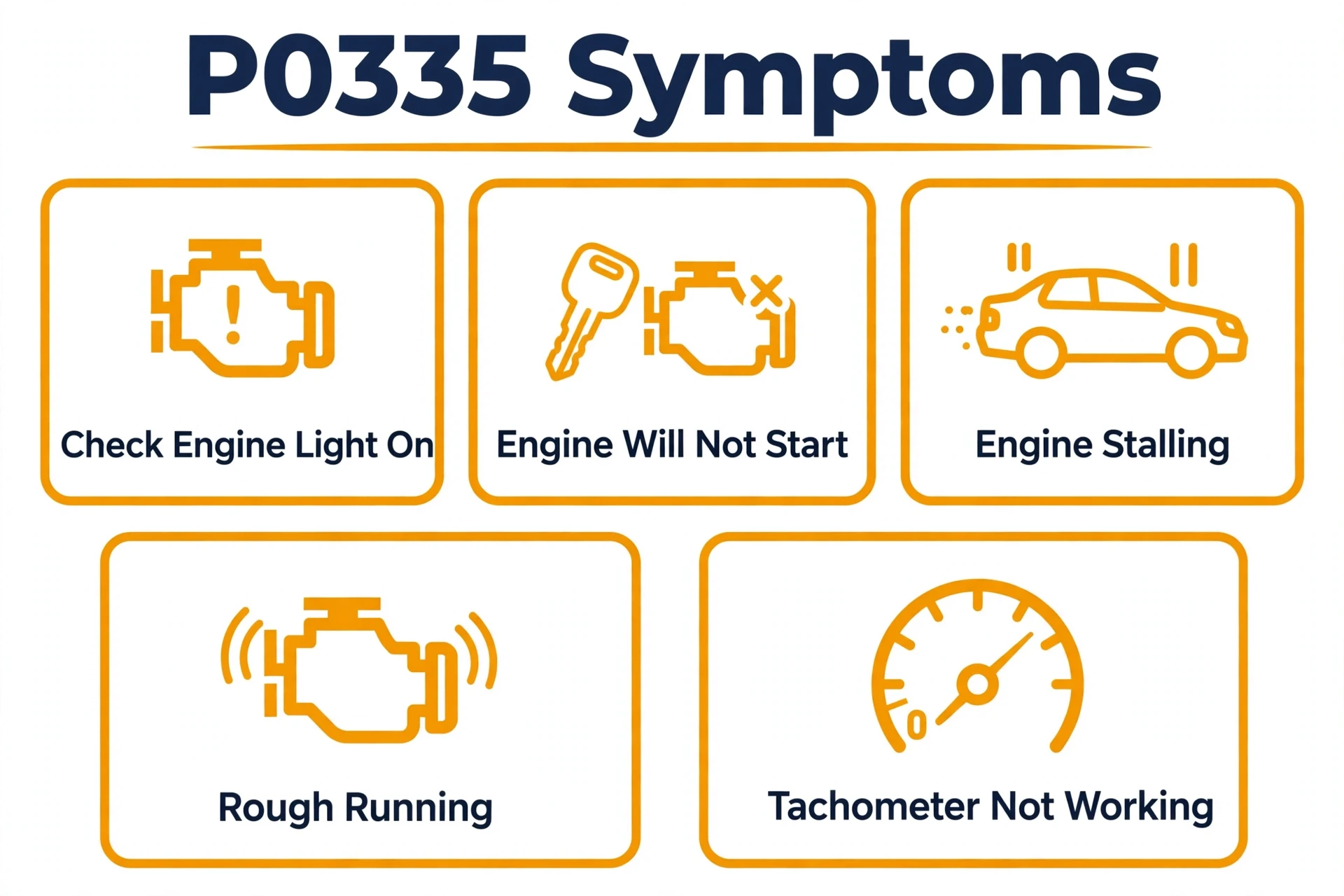
With P0335, you usually know something is wrong before you ever pull out a scanner. The classic pattern is a crank-no-start or an engine that dies without warning. Depending on how the failure shows up, you may notice:
- Engine cranks but will not start. Without crank position data, the PCM will not authorize fuel injection or spark.
- Engine stalls or dies while driving, sometimes at idle and sometimes under load.
- Hard starting. The engine cranks much longer than normal before it catches, or it catches and then dies.
- Rough idle or engine misfires, with P0300-series misfire codes often stored alongside P0335.
- Hesitation or stumbling under acceleration, plus reduced engine power.
- Check engine light on, sometimes flashing when misfires are severe.
- Dead or erratic tachometer, since some vehicles feed the tach from the crankshaft signal.
What does the p0335 code feel like from the driver’s seat? Often it starts as an intermittent problem. Heat makes failing crank sensors act up, so the car may start fine when cold, stall once it warms up, then restart after it cools down. An intermittent P0335 is in some ways harder to live with than a permanent one, because you never know when it will leave you stranded.
Common Causes of P0335
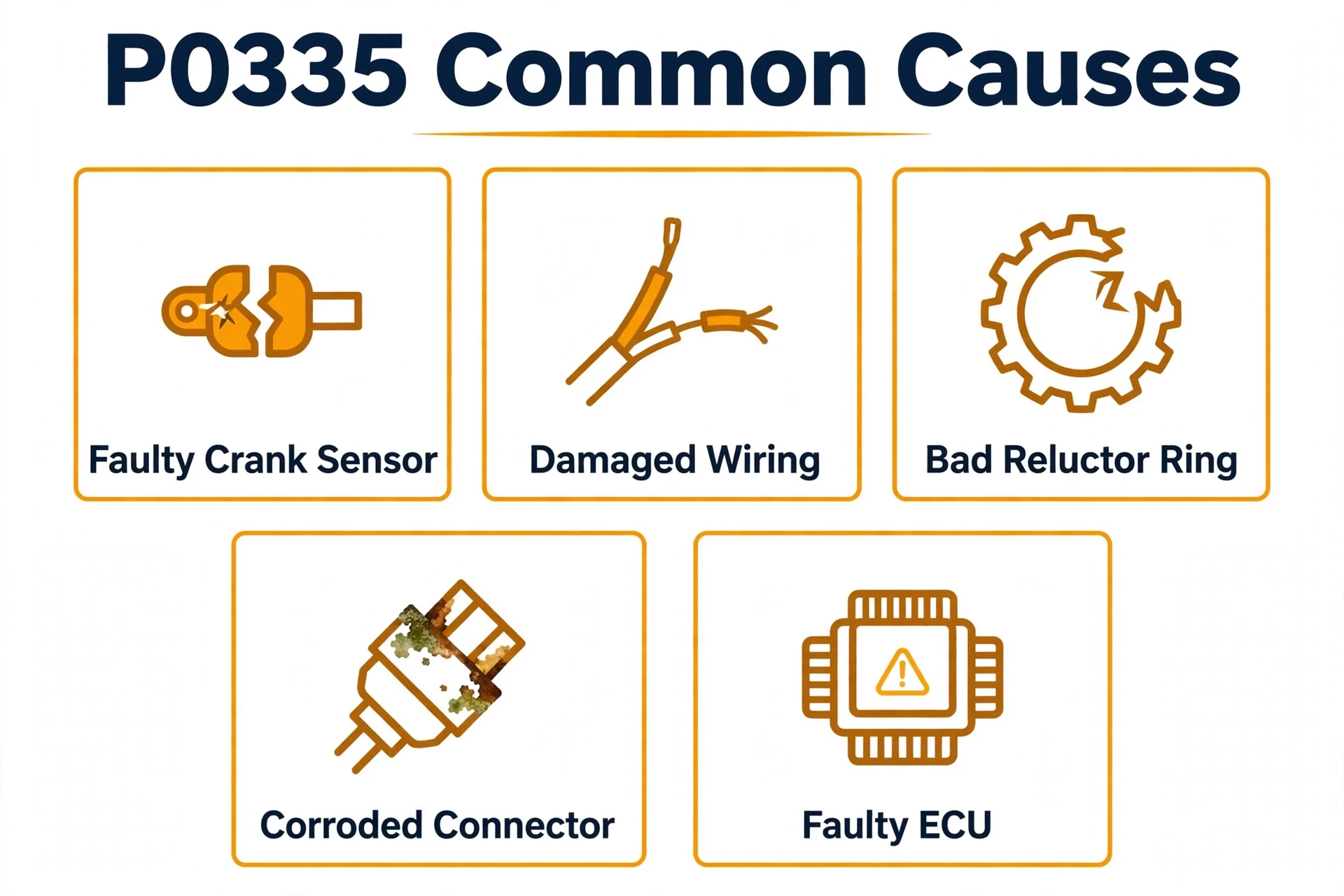
The most common cause of a P0335 code is a failed crankshaft position sensor. Heat cycling, age, and oil soaking from nearby leaks wear these sensors out. But because this is a circuit code, the wiring and everything around the sensor deserve equal suspicion:
- Faulty crankshaft position sensor: the single most common cause. Heat, vibration, and oil contamination kill it over time.
- Damaged wiring: frayed, burned, pinched, or broken wires between the sensor and the computer. The harness often runs close to hot exhaust parts and rotating components, so chafed insulation is common.
- Corroded or loose connector: green corrosion, oil inside the plug, bent pins, or a connector that is not fully seated will interrupt the signal.
- Damaged reluctor ring: the toothed wheel the sensor reads can crack, lose teeth, collect debris, or suffer a sheared keyway. Some sensors are also sensitive to air gap, so a sensor installed with the wrong clearance can set the code.
- Low battery or bad grounds: weak system voltage and poor grounds can corrupt the sensor signal.
- Failed PCM: rare, but the computer’s input circuit itself can fail. Only suspect this after the sensor, wiring, and reluctor ring all test good.
- Timing component problems: a worn or jumped timing belt or chain can throw the crank signal out of its expected pattern on some vehicles.
How to Diagnose P0335 (Do This Before Buying Parts)
Shops misdiagnose the p0335 code constantly by replacing the sensor first and asking questions later. Work through the circuit instead:
- Scan for companion codes first. P0300-series misfires, camshaft sensor codes like P0340, or timing codes change the picture.
- Inspect the connector and harness. Unplug the sensor and look for corrosion, oil, bent pins, and damaged insulation along the wiring, especially the last stretch near the sensor.
- Look for oil leaks. A leaking rear main seal can soak the crank sensor in oil. Fix the leak first, or the new sensor will fail the same way.
- Watch live RPM data. With an OBD2 scanner, monitor crankshaft RPM while cranking. A healthy circuit shows a steady cranking RPM. No reading points at the sensor or its wiring.
- Test the sensor. Magnetic sensors usually read between 200 and 1,000 ohms across their terminals. Hall-effect sensors need a 5-volt reference and a solid ground. Compare against your vehicle’s specs.
- Check the reluctor ring. Pull the sensor and shine a light into the hole, or use a borescope, and look for cracked or missing teeth and heavy debris.
- Scope the waveform if needed. A lab scope shows whether the signal is clean, erratic, or missing, which separates wiring faults from sensor faults.

How to Fix the P0335 Code
The right fix depends on what your diagnosis found:
- Clean and repair the connector and wiring: repair chafed insulation, clean corrosion, reseat loose plugs, and secure the harness away from heat and moving parts. This fixes more P0335 cases than most people expect.
- Replace the crankshaft position sensor: if the sensor tests bad or the wiring checks out, replacement is the most common and reliable fix. On many engines it is one bolt and one connector. Note the air gap: some sensors ship with a cardboard spacer that sets the correct gap and wears away on first start.
- Replace a damaged reluctor ring: labor intensive, since it often means major disassembly. Get a quote before committing.
- Fix oil leaks: stop the leak that soaked the sensor so the repair lasts.
- Repair timing components: if a worn belt or chain is behind the code, replace it.
- Replace or reprogram the PCM: last resort, only after everything else tests good.
- Clear the code and road test: erase the code with a scanner and drive through a few warm-up cycles to confirm it stays gone.

P0335 Repair Costs
Drivers always ask what a p0335 code costs to fix, and the answer depends on which part of the circuit failed. Here are the typical ranges:
| Repair | Cost Range |
|---|---|
| Crankshaft position sensor, DIY (part only) | $25 – $90 |
| Sensor replacement at a shop (parts + labor) | $150 – $350 |
| Wiring or connector repair | $100 – $250 |
| Reluctor ring replacement | $400 – $900+ |
| PCM replacement and programming | $500 – $1,200+ |
This is why the circuit check matters. A $150 wiring repair and a $900 reluctor ring job share the same code.
DIY vs Mechanic Verdict
You can do this at home: visual wiring and connector inspection, checking for oil leaks, reading and clearing codes with an OBD2 scanner, watching live RPM data while cranking, and replacing the sensor itself on most vehicles.
See a mechanic for: reluctor ring replacement (often requires major disassembly), PCM testing and programming, scope waveform diagnosis, and timing belt or chain work.
Bottom line: inspect the circuit yourself and handle the sensor swap if you are comfortable with it, but let a pro open up the engine or touch the computer.
Can You Drive With a P0335 Code?
No, this is not a code to drive on. Unlike some codes that only turn on the light, P0335 can shut the engine off without warning or leave you with a crank-no-start in a parking lot. The computer needs the crank signal to time spark and fuel, so the risk of stalling in traffic is real. Get it diagnosed promptly, and if the engine is already stalling, have it towed rather than risking the drive.
P0335 on Popular Vehicles
P0335 shows up across all brands, but some patterns are worth knowing:
- Nissan (Altima, Pathfinder, Sentra): the p0335 nissan code (nissan p0335) has well documented diagnostic criteria: no signal during cranking or an abnormal pulse pattern while running. Start with the sensor and its harness.
- Hyundai and Kia (Elantra, Sonata, Sorento, Santa Fe): owners report stalling and hard-start complaints with the p0335 hyundai code family. Sensor access is straightforward on many of these engines, which makes it a friendly DIY.
- Chevy and GM (Silverado, Impala, Cruze, Malibu): the p0335 chevy code (chevy p0335) sets when the crank signal goes missing over a set number of engine revolutions. Check companion codes carefully on these.
- Honda (Civic, Accord, CR-V): the p0335 honda code (honda p0335) usually comes down to the sensor or its connector, and oil leaks onto the sensor are a known repeat offender.
- Toyota (Camry, Corolla, Tundra, Land Cruiser): intermittent p0335 toyota reports are common (toyota p0335), with the light coming and going on its own as a heat-sensitive sensor fails.
- Ford (F-150, Escape, Explorer): the p0335 ford code (ford p0335) calls for a full code scan first, since timing and sensor circuit faults can overlap on high-mileage trucks.
P0335 is a generic OBD-II code with the same meaning on every make and model. The “Circuit A” label simply refers to the primary crankshaft sensor circuit.
P0335 vs P0336
P0335 and P0336 are neighbors in the crankshaft sensor family, but they mean different things. P0335 is a circuit malfunction: the computer is getting no signal, or an improper signal, from crankshaft position sensor “A”. P0336 is a range or performance fault: the sensor is sending a signal, but it falls outside the expected range or does not line up with the camshaft sensor. In practice, P0335 points you at the sensor, wiring, connector, and reluctor ring, while P0336 leans more toward a failing sensor, a stretched timing chain, or a damaged tone wheel. The rest of the family fills in the gaps: P0337 (circuit low input), P0338 (circuit high input), and P0339 (intermittent circuit fault).
Related Codes
- P0336: Crankshaft Position Sensor “A” Circuit Range/Performance
- P0337: Crankshaft Position Sensor “A” Circuit Low Input
- P0338: Crankshaft Position Sensor “A” Circuit High Input
- P0339: Crankshaft Position Sensor “A” Circuit Intermittent
- P0340: Camshaft Position Sensor “A” Circuit Malfunction (a common companion)
- P0300: Random/Multiple Cylinder Misfire Detected (often stored alongside P0335)
Video Walkthrough
Watch the video above for a visual walkthrough of P0335 diagnosis and crankshaft position sensor replacement before you read on.
Frequently Asked Questions
What is the most common cause of a P0335 code?
A failed crankshaft position sensor is the single most common cause. Heat cycling, vibration, and oil soaking wear the sensor out over time. That said, damaged wiring and corroded connectors cause a large share of P0335 cases too, so always inspect the circuit before buying parts.
Can I drive with a P0335 code?
It is not recommended. The engine can stall without warning or refuse to restart, because the computer needs the crank signal to time spark and fuel injection. If the car is already stalling, have it towed to a shop instead of risking the drive.
Will P0335 cause a no-start?
Yes, very often. Without crankshaft position data, the PCM will not authorize fuel injection or spark, so the engine cranks but never catches. A crank-no-start with no RPM signal on a scan tool is the classic P0335 pattern.
How do I diagnose P0335 myself?
Start with a visual inspection of the sensor connector and wiring harness, looking for corrosion, oil, and chafed insulation. Check for oil leaks soaking the sensor. Then use an OBD2 scanner to watch cranking RPM in live data: no RPM reading points at the sensor or its wiring. A multimeter resistance test of the sensor comes next.
How much does it cost to fix P0335?
A shop typically charges $150 to $350 for crankshaft position sensor replacement, parts and labor included. The sensor itself costs $25 to $90 if you do it yourself. Wiring repairs run $100 to $250, while a damaged reluctor ring can cost $400 to $900 or more because of the labor involved.
Will clearing the code fix P0335?
No. Clearing the code only erases the stored fault. It does nothing about the underlying circuit problem, so the code will return, usually within a few drive cycles, until the sensor, wiring, connector, or reluctor ring fault is actually repaired.
Can a bad crankshaft position sensor cause misfires?
Yes. When the crank signal drops out or turns erratic, ignition and fuel timing suffer, so misfires are common. P0300-series misfire codes are frequently stored alongside P0335. Fix the crank sensor circuit first, then recheck for misfires.
Conclusion
The P0335 code looks alarming because it can stop your engine, but it is really your car telling you the computer has lost track of the crankshaft. Work the circuit, not just the sensor: inspect the wiring and connector, check for oil leaks, watch the RPM signal, and test before you buy parts. Do that, and most P0335 cases end with a straightforward sensor replacement and a car that starts every time.
About the author: Written by the OBD2 Code Hub editorial team. Our diagnostic guides are built from real OBD-II data, manufacturer service information, and hands-on testing, so you get plain-English answers you can trust.